
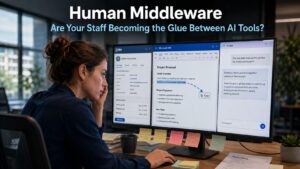
Human middleware is a term that describes something many business teams are living with right now without having a name for it. AI tools were introduced to make work faster and less repetitive. In a number of businesses, however, the adoption of those tools has quietly created a new layer of work: people spending significant portions of their day copying data between systems, checking whether information matches across different applications, and correcting AI outputs that almost worked but did not quite get there. The technology is in place. The repetitive work has not gone away. It has simply changed shape.
What Human Middleware Looks Like in Practice
The pattern is easy to miss because it tends to develop gradually alongside genuine productivity improvements. AI tools do make many tasks faster. Emails get drafted more quickly, reports take less time to compile, and information becomes easier to summarise. At the same time, new layers of manual coordination appear around those tools.
A team member downloads information from one system because another cannot access it directly. Someone pastes customer details into an AI tool to generate a response, then copies the finished result into a different application to send it. Data gets manually checked because nobody fully trusts what the automated systems are producing without verification. A staff member rewrites prompts repeatedly to give an AI tool the context it needs to produce something useful, because the underlying data is not in the format the tool expects.
Each of these actions takes only a few minutes. Together, across a working day, they represent a meaningful proportion of productive time spent helping software communicate with other software rather than doing the work those tools were supposed to support.
The strange thing is that businesses in this situation can still feel more productive overall. The AI tools are providing real benefits in some areas. But those benefits are partially offset by new coordination overhead that is less visible because it feels like normal work rather than wasted effort.
Why Human Middleware Develops
Human middleware typically develops because AI tools arrive faster than the systems underneath them evolve. A business adds one AI assistant, then another, then a separate AI-powered feature within an existing platform. Each tool provides value in its specific context. However, the tools were not designed to integrate smoothly with each other, and the data they need does not flow automatically between them.
The gaps that result are bridged by people. It is a natural response. A team member who needs information in a particular format, or who needs to transfer a result from one tool into another system, does what seems quickest in the moment: they handle it manually. This solution works. It creates no immediate problem. However, it creates a habit, and habits replicate across teams and departments.
Data quality compounds the issue. When the information feeding an AI tool is inconsistent, incomplete, or held in a format the tool does not expect, human effort is required to prepare it, check it, and correct the outputs it produces. A tool that should reduce manual effort instead creates a validation step that was not there before.
Our article on why AI projects stall covers the related pattern of AI investments failing to deliver the expected value, often because the underlying data environment and system integration were not adequately considered before the tool was deployed.
The Cost That Does Not Appear on the Dashboard
The cost of human middleware is real but difficult to measure through standard productivity tools. Staff are busy. Tasks are getting completed. The AI investment appears to be delivering value in the areas it was designed for. The problem is that time lost to coordination, data transfer, and manual correction is not being tracked against the AI investment. It is simply absorbed into the working day as background overhead.
Beyond the time cost, there is an energy cost that matters for different reasons. Switching repeatedly between applications, translating data from one format to another, and checking outputs against sources is cognitively tiring in a way that does not produce the sense of achievement that completing a meaningful task does. Staff who spend much of their day as human middleware often report that their work feels busy but unsatisfying. Busy days that feel productive on the surface can mask a significant mismatch between effort and output.
For businesses in Eastbourne and across Sussex that are investing in AI tools as a way to improve efficiency and free their teams for higher-value work, the presence of significant human middleware is a sign that the technology strategy needs reviewing. The goal of AI adoption is to reduce the time people spend on routine information-handling, not to replace one form of it with another.
How to Identify Human Middleware in Your Business
Identifying human middleware requires looking at how work actually flows through the business rather than how it is supposed to flow. A few specific questions help surface the problem.
Where are staff regularly copying information from one system to another? Any manual data transfer that happens repeatedly is a candidate for automation or integration. If the transfer is happening because two systems cannot communicate directly, that is the root cause to address.
Where are AI outputs being routinely corrected before they are used? Some correction is normal and expected. Systematic correction of the same types of error suggests either that the tool is not well-matched to the task or that the input data quality needs improving before the AI can produce reliable outputs.
Where do staff describe their work as primarily checking or translating rather than creating or deciding? These are roles where human middleware has taken hold most deeply. The person concerned is primarily serving as a connector between systems rather than using their expertise to produce value.
Our article on data security foundations and system complexity covers how the gradual accumulation of disconnected tools creates exactly the kind of environment in which human middleware thrives, and why understanding how information moves through a business is a prerequisite for managing it well.
What a Better-Integrated Approach Looks Like
Addressing human middleware requires a shift in focus from adding tools to improving how information flows through the business. Rather than evaluating each AI tool in isolation, the question to ask is whether the systems your team uses allow information to move smoothly between them, and whether the data those systems hold is consistent and reliable enough to support AI processing without constant human correction.
Integration between tools reduces the manual transfer steps that create human middleware. Where two systems can share data directly, the staff member who was bridging that gap manually is freed to do something more valuable. Microsoft 365 provides a well-integrated environment for exactly this kind of connected working, and our article on business automation and reducing manual work covers how businesses can use the tools already available to them to automate the most common repetitive handoffs.
Data quality improvements reduce the correction overhead. When the information feeding AI tools is complete, consistently formatted, and held in the right places, the outputs those tools produce are more reliable and require less human validation before they can be used. This is a less glamorous investment than acquiring a new tool, but it often delivers more of the productivity improvement that AI adoption was supposed to provide.
What This Means For Businesses
Human middleware is a sign that technology adoption has run ahead of integration and data quality. It is not a reason to pull back from AI tools. It is a reason to review how those tools connect with each other and with the underlying systems through which the business actually runs.
For business owners and directors, the practical starting point is asking your team directly where they spend time moving information between systems, checking AI outputs, or bridging gaps between tools that do not communicate well. Their answers will identify where the integration work is needed and where data quality improvements would deliver the most return.
Our managed IT services include technology strategy reviews and Microsoft 365 integration assessments for businesses across Sussex and the South East, helping business owners identify where human middleware has taken hold and what a better-connected technology environment looks like for their specific operations.
Final Thoughts
AI tools should reduce the amount of time your team spends on routine information-handling. When they are creating more of it in a different form, the technology strategy needs attention. Human middleware is the symptom of disconnected tools and inconsistent data. Addressing the root cause rather than accepting the workaround is what delivers the efficiency that AI adoption was supposed to provide in the first place.
Your team should be solving problems, helping clients, and making decisions. If they are spending their day helping software talk to other software, that is worth changing.
Human middleware describes the situation where staff spend significant time manually bridging gaps between AI tools and business systems, copying data between applications, correcting AI outputs, and checking information that systems cannot share or validate automatically. The term reflects the role these staff members end up playing, not as decision-makers or value creators, but as connectors between disconnected technologies.
Look for staff who regularly copy information between systems manually, who routinely correct the same types of AI output before using them, or who describe their work primarily as checking or translating rather than creating or deciding. If these patterns are common, human middleware has likely developed. The busier and more productive the business feels overall, the easier it is to miss.
Not necessarily. Human middleware often develops because AI tools were adopted faster than the integration and data quality work needed to support them. The tools themselves may be well-suited to the tasks they were chosen for. The problem is usually that the systems beneath them are not connected well enough, or the data feeding them is not consistent enough, to allow the tools to work reliably without human correction.
Identify where the most time is being spent on manual data transfer and output correction, and then trace why each instance is happening. Usually the root cause is either a lack of direct integration between two systems or inconsistent data quality in one of them. Addressing the root cause, rather than improving the workaround, is what produces a lasting reduction in the manual overhead.
Yes. Microsoft 365 provides a well-integrated environment where applications share data directly, reducing the manual transfer steps that create human middleware. Tools like Power Automate can connect Microsoft 365 applications with other business systems, automating the handoffs that staff currently handle manually. Getting more from what is already in place is often the most accessible starting point for reducing integration-related overhead.


