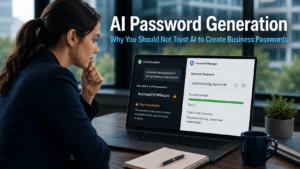
AI password generation feels like a natural shortcut. AI tools can write reports, draft communications, and produce complex content on demand. Asking one to generate a strong 16-character password packed with symbols, numbers, and mixed-case letters seems entirely reasonable. The result looks exactly right. Online password strength checkers rate it highly. Some suggest it would take centuries to crack. Research, however, tells a different story, and the difference matters significantly for any business relying on passwords to protect its systems and data.
Why AI Password Generation Produces Weaker Passwords Than They Appear
Researchers tested a range of AI tools by asking them to generate secure passwords. On the surface, the outputs were impressive. Long strings of characters, a mix of upper and lower case letters, numbers, and symbols, all the hallmarks of a strong password. However, when those passwords were subjected to deeper analysis, a problem emerged that standard password strength checkers cannot detect.
AI tools are built on what are called large language models. These systems are trained to predict what text should logically come next based on patterns learned from enormous quantities of existing text. They are extraordinarily good at producing output that looks natural, plausible, and well-formed. That capability is precisely what makes them useful for writing, summarising, and generating content.
However, it is also what makes them unsuitable for password generation. Strong passwords depend on genuine randomness. The more unpredictable each character in a password is, the harder it is to crack through a brute-force attack, where an attacker tries vast numbers of possible combinations at high speed. A large language model is not designed to produce true randomness. It is designed to produce plausible output. These are not the same thing.
When researchers analysed AI-generated passwords closely, they found repeating structural patterns across different passwords. Some outputs were near-duplicates of each other. Many followed similar templates. Notably, none of the AI-generated passwords contained repeating characters within a single password. That sounds like good practice, but genuine randomness includes repetition sometimes. The consistent absence of it reveals that the passwords were following learned rules rather than being generated unpredictably.
What Entropy Reveals About AI-Generated Passwords
Researchers used a technical measure called entropy to assess the true unpredictability of the AI-generated passwords. Entropy measures how difficult it would be to guess or reconstruct a sequence through brute-force methods. A high-entropy password is genuinely hard to crack. A low-entropy password, even one that looks complex, can be cracked considerably faster than its visual complexity suggests.
The AI-generated passwords scored significantly lower on entropy than a genuinely random 16-character password should. This means that despite appearing strong and scoring well on standard password checkers, they could be cracked meaningfully faster than a password generated through a properly random process.
The reason standard password checkers miss this is that they assess visible complexity. They count character types, check for dictionary words, and evaluate length. They do not assess the hidden structural patterns that a large language model introduces. A password that contains symbols, numbers, and mixed-case letters will score well on a standard checker regardless of how predictable its underlying structure is.
Even some of the most capable AI models recognise this limitation. Some have begun issuing warnings when asked to generate passwords for sensitive accounts, advising users not to rely on AI-generated credentials for security-critical purposes. That acknowledgement from the tools themselves is a clear indication of where the boundary of their appropriate use lies.
The Right Tool for Password Generation
The solution is straightforward and already available to every business. A password manager with a built-in password generator uses cryptographic randomness rather than language model prediction to create passwords. Cryptographic randomness means the output is mathematically unpredictable in a way that a large language model fundamentally cannot replicate.
The difference is not visible to the eye. A cryptographically random password and an AI-generated password may look identical on screen. The difference lies in how they were produced and how resistant to brute-force attack they actually are when subjected to the statistical analysis that serious password cracking tools apply.
A password manager also solves the other major challenge in business password security: storage and recall. Staff do not need to remember complex credentials because the manager stores and fills them automatically. Every account can have a unique, strong password without placing any memory burden on the individual. The only password anyone needs to remember is the single master password that unlocks the manager itself.
Our article on secure passwords and how to protect your business covers the full approach to password security, including how to implement a password manager across a business team effectively. Our article on weak business passwords covers why poor credential choices remain one of the most common and exploitable vulnerabilities in business security.
Where AI Tools Do and Do Not Belong in Business Security
The finding about AI password generation is not a reason to distrust AI tools broadly. It is a reminder that tools work best when matched to what they are actually designed to do.
Large language models are designed to produce plausible, coherent text based on learned patterns. They are excellent at drafting, summarising, structuring, and generating content. They are not designed to produce true randomness, which is the specific property that makes cryptographic tools appropriate for security tasks like password generation.
Using AI to draft a security policy, summarise a threat briefing, or help structure a staff awareness communication is entirely appropriate. Asking it to generate the credentials that protect your business accounts is not. The distinction is not about capability in a general sense. It is about fitness for the specific task.
This kind of clear-eyed assessment of where AI belongs and where it does not is part of using these tools well. Our article on why AI projects stall covers the broader pattern of how businesses get the most from AI tools when they start from a specific, well-matched business need rather than applying AI broadly without assessing fit.
What This Means For Businesses
For businesses that have already begun using AI tools across their team, AI password generation is worth flagging as a specific practice to avoid. If any team members are currently using AI tools to generate passwords for business accounts, those passwords should be regenerated using a proper password manager with a built-in cryptographic generator.
For businesses in Brighton and across Sussex reviewing their overall approach to password security, the clear recommendation is a business-wide password manager deployed across all staff accounts. This eliminates reliance on individually chosen passwords, removes the temptation to use AI tools for credential generation, and ensures every account has a genuinely strong, unique password without placing an unreasonable memory burden on your team.
Our managed IT services include password manager deployment and security configuration for businesses across Sussex and the South East, ensuring your team’s credentials are generated and managed through tools designed specifically for this purpose.
Final Thoughts
AI password generation looks convincing but is not what it appears. The passwords it produces may score well on standard checkers and look visually complex, but they contain hidden patterns that reduce their true strength against the methods real attackers use. A password manager with a cryptographic generator produces credentials that are genuinely unpredictable in a way that AI cannot replicate.
AI is an excellent productivity tool. Password generation is one of the specific tasks it is not suited to. Keeping these two things separate ensures your business benefits from AI where it genuinely helps while keeping its security credentials where they belong: in tools designed specifically for the job.
AI tools are built on large language models that predict plausible text based on learned patterns. They are not designed to produce true randomness, which is what makes passwords genuinely unpredictable. Research shows AI-generated passwords contain hidden structural patterns that reduce their resistance to brute-force cracking, even when they look complex and score well on standard password checkers.
Entropy is a measure of how unpredictable a sequence is. Higher entropy means a password is harder to guess or reconstruct through brute-force attack. AI-generated passwords score lower on entropy than genuinely random passwords of the same length, meaning they can be cracked faster than their visual complexity suggests. Standard password strength checkers do not measure entropy and therefore cannot detect this weakness.
A password manager with a built-in password generator uses cryptographic randomness rather than language model prediction. This produces passwords that are mathematically unpredictable in a way AI cannot replicate. The password manager also stores and fills credentials automatically, so staff do not need to remember complex passwords individually.
Yes, for many tasks. AI tools are appropriate for drafting security policies, summarising threat briefings, structuring staff awareness materials, and similar content-focused activities. The specific issue with password generation is the need for true cryptographic randomness, which is a property large language models are not designed to provide. Matching the tool to the task is the key distinction.
There is no reliable way to identify AI-generated passwords after the fact through visual inspection. The safest approach is to regenerate passwords for all business accounts using a password manager with a built-in cryptographic generator, particularly for accounts protecting sensitive data, financial systems, and cloud platforms. This replaces any potentially weak credentials with ones that are genuinely random.