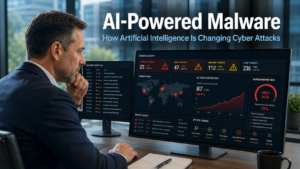
AI-powered malware has moved from a theoretical concern to a documented and rapidly growing reality. Research now shows that 80% of ransomware attacks are powered by artificial intelligence. Four in every five attacks on businesses are being conducted not primarily by human operators making individual decisions, but by AI systems running automated campaigns at a speed and scale that was simply not possible before. For business owners, this is a significant shift in the threat they face and in what an adequate defence needs to look like.
What AI-Powered Malware Is and How It Differs From Traditional Attacks
Traditional cyber attacks required human involvement at most stages. An attacker would identify a target, craft a phishing email, wait for a response, and then manually progress through a network once initial access was gained. This took time, effort, and skill. It also limited how many businesses an attacker could target simultaneously.
AI-powered malware changes this fundamentally. AI systems can identify potential targets, generate convincing phishing content tailored to each recipient, probe systems for weaknesses, and progress through a network, all at a speed and volume that no human team could match. Where a human attacker might attempt one approach to breaking into a system, an AI-driven campaign can attempt thousands of variations in the same timeframe.
This asymmetry is one of the defining characteristics of the current threat environment. A business must defend every possible entry point successfully, every time. An attacker using AI needs to find only one that works. The imbalance is not new, but AI has made it dramatically more pronounced.
How AI Is Being Used in Cyber Attacks Today
AI-powered malware is not a single tool. It describes a range of techniques where AI enhances different stages of an attack.
Phishing is one of the clearest examples. AI systems can generate convincing, personalised phishing emails at scale. Rather than sending a generic message to thousands of recipients, AI can craft messages that reference the recipient’s name, employer, recent activity, or business context, making them significantly harder to identify as fraudulent. The volume and quality of phishing attacks has risen sharply as a result. Our article on phishing scams tripling covers this trend in detail.
Password cracking benefits similarly from AI. Automated tools can now test enormous numbers of credential combinations at speeds that make many previously adequate passwords vulnerable. This is one of the reasons that long, unique passwords and multi-factor authentication have become essential rather than advisory for business accounts.
Deepfake technology is an emerging and particularly concerning application. AI can generate audio that convincingly mimics a specific person’s voice or video that places their likeness in a fabricated scenario. In a business context, this enables phone or video call fraud where a staff member believes they are speaking with a trusted colleague or senior figure. Our article on business identity fraud covers how these impersonation attacks are being used to target businesses of all sizes.
CAPTCHA bypass tools, which are designed to solve the puzzle-based verification systems that distinguish human users from automated ones, are also increasingly AI-driven. This allows automated attack tools to proceed through login pages and web forms that were previously an effective barrier against automated access attempts.
Why Traditional Security Approaches Are Struggling to Keep Pace
Conventional security tools were built to identify known threats. Antivirus software compares files against a database of recognised malware signatures. Firewalls block traffic that matches defined patterns of malicious behaviour. These approaches work well against attacks that have been seen before.
AI-powered malware can generate novel variations of itself that do not match existing signatures. It adapts its behaviour based on the environment it encounters. The traditional model of detecting a threat, adding it to a database, and deploying an update to block it was always reactive. Against AI-driven attacks that evolve faster than human security teams can respond, that lag becomes a significant vulnerability.
This does not mean that established security practices no longer matter. Patching, updates, strong passwords, and multi-factor authentication remain important. However, they are no longer sufficient on their own. The threat has changed, and the defence needs to reflect that.
How Businesses Can Build a Stronger Defence Against AI-Powered Malware
The most effective response to AI-powered malware is a layered approach that combines strong security fundamentals with more sophisticated, behaviour-based detection tools.
Security fundamentals remain the essential foundation. Keeping all software patched and updated closes the known vulnerabilities that automated attack tools probe for. Strong, unique passwords and multi-factor authentication on all business accounts reduce the value of credential theft. Regular backups, particularly immutable backups that cannot be modified or deleted by an attacker, provide a recovery path if ransomware does reach your systems. Our article on immutable backup storage covers why this is now the most important single protection against ransomware.
Beyond the fundamentals, AI-powered defensive tools are becoming more accessible for businesses of all sizes. Security systems that monitor network behaviour and flag unusual activity, rather than simply checking against known threat signatures, are significantly more effective against novel AI-driven attacks. These tools learn what normal looks like within a specific network and raise alerts when something deviates from that pattern, even if the specific attack type has not been seen before.
Human oversight remains essential alongside these tools. Automated systems can flag suspicious activity, but a person needs to review, assess, and decide how to respond. The combination of AI-assisted detection and human judgement is more effective than either alone.
Staff awareness also continues to matter. AI-powered phishing emails are more convincing than their predecessors, but staff who understand the warning signs and feel comfortable reporting suspicious messages are still a meaningful part of the defence. Our article on overconfident employees covers why awareness needs to be ongoing and realistic rather than a one-off exercise.
Our cyber security page outlines how a structured, layered approach to security helps businesses build defences appropriate for the current threat environment.
What This Means For Businesses
The rise of AI-powered malware raises the baseline of what adequate business security looks like. Businesses that have not reviewed their security posture recently may find that what was considered sufficient two or three years ago is no longer sufficient today.
For business owners and directors in Eastbourne and across Sussex, the practical implication is a direct question: does your current security setup include behaviour-based detection, not just signature-based tools? Are your backups immutable and tested? Is multi-factor authentication active on all accounts? Is your team receiving current, relevant awareness training?
These are not questions that require deep technical knowledge to ask. They do require honest answers and, where the answer is no or uncertain, a plan to address the gap. Working with a managed IT provider that keeps pace with the evolving threat environment is one of the most reliable ways for a smaller business to maintain security appropriate for the risks they actually face.
Our managed IT services include ongoing security monitoring, patch management, and threat awareness support for businesses across Sussex and the South East, calibrated to the actual risk profile of the businesses we work with rather than a one-size-fits-all approach.
Final Thoughts
AI-powered malware represents a genuine and growing escalation in the sophistication of cyber threats. The speed, scale, and adaptability of AI-driven attacks outpaces what traditional, reactive security tools were designed to handle. Recognising this and responding with a layered, proactive defence is the appropriate response.
The good news is that AI is also on the defensive side of this equation. Businesses that invest in behaviour-based security tools, maintain strong fundamentals, and ensure their team understands the current threat landscape are in a meaningfully stronger position than those relying on approaches that have not kept pace with how attacks have changed.
AI-powered malware describes cyber attacks where artificial intelligence is used to automate, accelerate, or enhance different stages of the attack. This includes generating convincing phishing emails, probing systems for weaknesses at high speed, adapting attack behaviour to avoid detection, and cracking passwords through rapid automated testing. Research shows 80% of ransomware attacks now use AI in some form.
Traditional security tools detect threats by matching them against known signatures of malicious behaviour. AI-powered malware can generate novel variations of itself that do not match existing signatures, and can adapt based on the specific environment it encounters. This means signature-based tools alone are less effective, and behaviour-based detection is increasingly important.
Yes. Multi-factor authentication remains one of the most effective protections available, including against AI-powered attacks. Even when an AI system cracks or steals a password, multi-factor authentication prevents that credential from being used without the additional verification step. It is a protection that AI attacks have not rendered obsolete.
A layered security approach combines multiple types of protection so that if one is bypassed, others remain in place. For AI-powered malware, this typically means strong password practices, multi-factor authentication, patching and updates, behaviour-based threat detection, immutable backups, and staff awareness training working together. No single measure is sufficient against sophisticated AI-driven attacks.
A managed IT provider can deploy and maintain behaviour-based security monitoring tools, ensure all software is patched promptly, configure multi-factor authentication across your accounts, manage immutable backups, and provide staff awareness training that reflects current threats. They bring expertise in the evolving threat landscape that most businesses do not have in-house, and they monitor your systems continuously rather than reactively.