AI Projects Stalling? Why Most Business AI Initiatives Get Stuck and How to Fix It

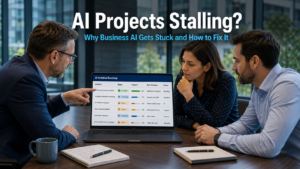
Business professionals in a meeting reviewing an AI project roadmap on a laptop in a modern office, representing the challenge of AI projects stalling and how to build momentum for business AI initiatives IMAGE_PROMPT: Photorealistic, high-resolution, 16:9 landscape corporate photography. Scene: Three business professionals, two men and one woman, sit around a modern conference table in a bright contemporary meeting room. They look together at an open laptop screen showing a project roadmap or progress dashboard with AI initiative milestones, some marked as complete and others stalled or paused. One professional points at the screen with a focused and problem-solving expression. The others lean in with engaged, thinking expressions. A notepad with written notes and a coffee mug sit on the table. Large windows behind them show soft natural daylight and a blurred office exterior. Colour palette: deep navy blue, warm slate grey, and clean white with soft blue accent tones from the laptop screen. No robots, no holograms, no cartoon elements. Photorealistic and magazine-cover quality. Sharp focus on the group and the laptop screen. Camera style: medium wide shot from a slight elevated angle showing the group and screen naturally, shallow depth of field softening the background. Composition: group centred in the frame, laptop screen visible and dashboard content contextually readable. Lighting: bright soft natural office daylight from large windows combined with a gentle cool screen glow. Headline text overlay at upper centre in large bold white sans-serif font reads: "AI Projects Stalling?" with a light blue subtitle beneath reading: "Why Business AI Gets Stuck and How to Fix It". Text must be sharp, prominent, and easy to read on both desktop and mobile. No company logos, no URLs, no branding elements. WORDPRESS_HTML: htmlAI projects stalling is one of the most common and least-discussed problems in business technology right now. Businesses across every sector have experimented with AI tools, run pilots, and attended demonstrations. Yet a significant proportion of those initiatives never make it into day-to-day use. Research suggests around half of all business AI projects are still stuck in proof-of-concept mode, even as most businesses fully expect to increase their AI budgets. Belief in AI is widespread. Momentum is not. The reason is rarely the technology itself. The obstacles that hold AI projects back are more familiar than most business owners expect. The Most Common Reason AI Projects Stall The single most common cause of AI projects stalling is a lack of clarity about what the project is actually trying to achieve. Many businesses start an AI initiative with a general sense that AI is important and that they should be doing something with it. That motivation is understandable. The problem is that it does not translate into a clear target, a measurable outcome, or a definable point at which the project can be judged to have succeeded. When there is no specific business problem to solve, projects drift. Teams experiment with tools, generate interesting outputs, and have productive conversations. However, nobody can say with confidence what success looks like, how progress will be measured, or when the initiative is ready to move from pilot to operational use. In the absence of those answers, momentum stalls and the project quietly loses priority. This pattern plays out in businesses of all sizes. The AI tools themselves often work well. The issue is the framework around them. Without a specific, concrete outcome to work towards, the project has no natural momentum and no clear ending. Governance Concerns Are Blocking Progress Governance is the second major reason AI projects stall. Business leaders are right to think carefully about security, data privacy, and compliance when introducing AI tools. These are legitimate concerns, particularly for businesses that handle sensitive client information or operate in regulated sectors. However, the way many businesses respond to these concerns creates its own problem. Rather than putting simple, practical boundaries in place and moving forward within them, projects get paused while teams search for perfect answers. Every question about data handling, liability, or regulatory compliance becomes a reason to delay rather than a problem to address and document. The result is that months pass with no material progress, and the people involved lose confidence and energy. The businesses that make progress on AI do not wait for perfect governance. They define what the AI is allowed to do, what always requires a human check, and what data it can and cannot access. These boundaries are not complex to establish. They do require someone to make decisions and write them down. That deliberate simplicity unlocks the progress that waiting for perfect answers prevents. Our article on generative AI for business covers how businesses are approaching AI adoption practically and where the most accessible starting points tend to be. The Confidence Gap Is Holding Businesses Back A third obstacle is the skills and confidence gap. AI tools are increasingly accessible, but they still need people who understand how to manage them, evaluate their outputs critically, and step in when something looks wrong. Most businesses that have experimented with AI are not short on ambition. They are short on confidence that they can handle AI responsibly and effectively without specialist expertise. This gap often manifests as a reluctance to commit. Businesses are willing to trial AI, but unwilling to integrate it into processes they depend on until they feel more certain about what they are doing. The problem is that certainty tends to come from doing, not from waiting. Projects that never move beyond the pilot stage never generate the learning that builds confidence. Interestingly, most business leaders already have a realistic view of where this is heading. The majority expect that AI decisions will continue to involve human oversight for the foreseeable future, and that the long-term model will be one where people and AI share responsibility rather than AI operating autonomously. This is a sensible and grounded position. It is also one that makes starting considerably less daunting than the grand transformation narrative sometimes suggests. What the Businesses Making Progress Are Doing Differently There is a consistent pattern among businesses that have successfully moved AI from pilot to practical use. Three characteristics stand out. First, they tie AI to a specific and modest business outcome. Not a transformation of the entire operation, but a measurable improvement in one area. Reducing the time spent on a specific reporting task. Improving the speed of a monitoring process. Saving hours per week on email drafting. The outcome is concrete, the improvement is measurable, and success is recognisable. That specificity is what turns an experiment into a project. Second, they establish clear boundaries early. They define what the AI tool is permitted to do independently and what always requires a person to review the output before it is acted on. This clarity removes the uncertainty that leads to paralysis. It also makes the AI safer to use, because the boundaries themselves are part of the governance framework rather than something that needs to be resolved before work can begin. Third, they scale deliberately rather than broadly. Rather than deploying multiple AI tools simultaneously and hoping something proves its value, they focus on one area, prove the benefit there, learn from it, and then expand. This approach generates real evidence of value, which builds the internal confidence and organisational support that makes the next step easier to take. For businesses in East Grinstead and across Sussex that have experimented with AI tools through Microsoft 365 Copilot or similar platforms, these three characteristics provide a practical framework for getting more from what is already in place. Our article on IT budget pressure and technology decisions covers how to evaluate technology investment based on genuine business need rather than broader market pressure. Humans Remain in the Loop One of the most helpful realities about AI adoption in business is that nobody is being asked to hand over full control to an automated system. The expectation among most business leaders is that AI will handle specific tasks or surface information, while people retain oversight and make the final call. That is not a limitation of current AI capability. It is a sensible and appropriate approach that reflects how these tools work best. AI fails most visibly when it is given too much autonomy too quickly and when nobody is checking whether its outputs are accurate and appropriate. The businesses with the best results keep humans firmly in the loop, use AI to reduce effort rather than replace judgement, and treat errors as learning opportunities rather than failures. This model produces better outcomes and builds the kind of confidence that allows the scope of AI use to expand naturally over time. What This Means For Businesses If your business has experimented with AI but not yet embedded it into daily operations, you are in the majority. The gap between intention and implementation is wide across most businesses, and the reasons are consistent. Unclear goals, unresolved governance questions, and a confidence deficit are holding back AI initiatives that the technology itself is capable of delivering on. For business owners and directors, the practical starting point is a single, specific question: what is one task your team spends significant time on that follows a predictable pattern and could plausibly be handled faster or better with AI assistance? Start there. Define what success looks like. Put simple boundaries in place. Measure the improvement. Then decide what comes next. Our managed IT services include guidance on AI tool adoption and Microsoft 365 Copilot configuration for businesses across Sussex and the South East. We can help you identify the right starting points for your specific business and build the governance framework that allows you to move forward with confidence. Final Thoughts AI projects stalling is not a sign that AI does not work. It is almost always a sign that the project lacked the clarity, boundaries, or deliberate pacing that turns a good idea into a working tool. The technology is rarely the problem. The framework around it usually is. Start specific, set clear boundaries, move deliberately, and keep people in the loop. That combination does not produce perfect AI deployment. It produces real progress, which is considerably more valuable. Frequently Asked Questions Why do so many business AI projects fail to move beyond the pilot stage? The most common reasons are unclear goals, unresolved governance concerns, and a lack of internal confidence. When a project does not have a specific, measurable outcome to work towards, it drifts without natural momentum. When governance questions are treated as blockers rather than boundaries to define and work within, progress stalls. When teams lack confidence in their ability to manage AI responsibly, they hesitate to commit to operational use. What does good AI governance look like for a smaller business? It does not need to be complex. It means defining what the AI tool is permitted to do independently, what always requires a human review before any action is taken, and what data it can and cannot access. Documenting these decisions clearly is more important than making them perfect. Simple, explicit boundaries allow work to proceed safely rather than waiting for comprehensive answers that may never arrive. How do I choose the right AI project to start with? Look for a task that is repetitive, time-consuming, and follows a predictable pattern. Ideally it should be something where the output can be reviewed by a person before being used, and where the improvement would be measurable. Email drafting, meeting summarisation, report generation, and routine data processing are all common starting points that have proven accessible for businesses using Microsoft 365 Copilot. Will AI replace the need for human oversight in business processes? Not in the near term, and most business leaders do not expect it to. The model that produces the best results is one where AI handles specific tasks or surfaces information, and people retain oversight and make the final decisions. This approach produces better outcomes and builds the internal confidence that allows AI use to expand gradually over time. How can a managed IT provider help with AI adoption? A managed IT provider can help identify the right starting points based on your specific business operations, configure AI tools such as Microsoft 365 Copilot appropriately, establish governance boundaries, and support your team through the early stages of adoption. They bring practical experience of what works for businesses of similar size and sector, which reduces the trial-and-error that slows many AI initiatives. INTERNAL_LINKS: Anchor Text: generative AI for business Suggested Page: https://mytechteam.uk/generative-ai-for-business-what-ninety-percent-are-doing/ Anchor Text: IT budget pressure and technology decisions Suggested Page: https://mytechteam.uk/it-budget-pressure-spending-technology-right-reasons/ Anchor Text: managed IT services Suggested Page: https://mytechteam.uk/it-management/ Anchor Text: how Microsoft Copilot can help your team work smarter Suggested Page: https://mytechteam.uk/how-microsoft-copilot-can-help-your-team-work-smarter/ Anchor Text: business automation and reducing manual work Suggested Page: https://mytechteam.uk/business-automation-free-your-team-from-spreadsheet-headaches/ Anchor Text: overconfident employees and AI risk Suggested Page: https://mytechteam.uk/overconfident-employees-hidden-cyber-security-risk/ TAGS: Blog, Guide, Info

AI projects stalling is one of the most common and least-discussed problems in business technology right now. Businesses across every sector have experimented with AI tools, run pilots, and attended demonstrations. Yet a significant proportion of those initiatives never make it into day-to-day use. Research suggests around half of all business AI projects are still stuck in proof-of-concept mode, even as most businesses fully expect to increase their AI budgets. Belief in AI is widespread. Momentum is not.

The reason is rarely the technology itself. The obstacles that hold AI projects back are more familiar than most business owners expect.

The Most Common Reason AI Projects Stall

The single most common cause of AI projects stalling is a lack of clarity about what the project is actually trying to achieve. Many businesses start an AI initiative with a general sense that AI is important and that they should be doing something with it. That motivation is understandable. The problem is that it does not translate into a clear target, a measurable outcome, or a definable point at which the project can be judged to have succeeded.

When there is no specific business problem to solve, projects drift. Teams experiment with tools, generate interesting outputs, and have productive conversations. However, nobody can say with confidence what success looks like, how progress will be measured, or when the initiative is ready to move from pilot to operational use. In the absence of those answers, momentum stalls and the project quietly loses priority.

This pattern plays out in businesses of all sizes. The AI tools themselves often work well. The issue is the framework around them. Without a specific, concrete outcome to work towards, the project has no natural momentum and no clear ending.

Governance Concerns Are Blocking Progress

Governance is the second major reason AI projects stall. Business leaders are right to think carefully about security, data privacy, and compliance when introducing AI tools. These are legitimate concerns, particularly for businesses that handle sensitive client information or operate in regulated sectors.

However, the way many businesses respond to these concerns creates its own problem. Rather than putting simple, practical boundaries in place and moving forward within them, projects get paused while teams search for perfect answers. Every question about data handling, liability, or regulatory compliance becomes a reason to delay rather than a problem to address and document. The result is that months pass with no material progress, and the people involved lose confidence and energy.

The businesses that make progress on AI do not wait for perfect governance. They define what the AI is allowed to do, what always requires a human check, and what data it can and cannot access. These boundaries are not complex to establish. They do require someone to make decisions and write them down. That deliberate simplicity unlocks the progress that waiting for perfect answers prevents.

Our article on generative AI for business covers how businesses are approaching AI adoption practically and where the most accessible starting points tend to be.

The Confidence Gap Is Holding Businesses Back

A third obstacle is the skills and confidence gap. AI tools are increasingly accessible, but they still need people who understand how to manage them, evaluate their outputs critically, and step in when something looks wrong. Most businesses that have experimented with AI are not short on ambition. They are short on confidence that they can handle AI responsibly and effectively without specialist expertise.

This gap often manifests as a reluctance to commit. Businesses are willing to trial AI, but unwilling to integrate it into processes they depend on until they feel more certain about what they are doing. The problem is that certainty tends to come from doing, not from waiting. Projects that never move beyond the pilot stage never generate the learning that builds confidence.

Interestingly, most business leaders already have a realistic view of where this is heading. The majority expect that AI decisions will continue to involve human oversight for the foreseeable future, and that the long-term model will be one where people and AI share responsibility rather than AI operating autonomously. This is a sensible and grounded position. It is also one that makes starting considerably less daunting than the grand transformation narrative sometimes suggests.

What the Businesses Making Progress Are Doing Differently

There is a consistent pattern among businesses that have successfully moved AI from pilot to practical use. Three characteristics stand out.

First, they tie AI to a specific and modest business outcome. Not a transformation of the entire operation, but a measurable improvement in one area. Reducing the time spent on a specific reporting task. Improving the speed of a monitoring process. Saving hours per week on email drafting. The outcome is concrete, the improvement is measurable, and success is recognisable. That specificity is what turns an experiment into a project.

Second, they establish clear boundaries early. They define what the AI tool is permitted to do independently and what always requires a person to review the output before it is acted on. This clarity removes the uncertainty that leads to paralysis. It also makes the AI safer to use, because the boundaries themselves are part of the governance framework rather than something that needs to be resolved before work can begin.

Third, they scale deliberately rather than broadly. Rather than deploying multiple AI tools simultaneously and hoping something proves its value, they focus on one area, prove the benefit there, learn from it, and then expand. This approach generates real evidence of value, which builds the internal confidence and organisational support that makes the next step easier to take.

For businesses in East Grinstead and across Sussex that have experimented with AI tools through Microsoft 365 Copilot or similar platforms, these three characteristics provide a practical framework for getting more from what is already in place. Our article on IT budget pressure and technology decisions covers how to evaluate technology investment based on genuine business need rather than broader market pressure.

Humans Remain in the Loop

One of the most helpful realities about AI adoption in business is that nobody is being asked to hand over full control to an automated system. The expectation among most business leaders is that AI will handle specific tasks or surface information, while people retain oversight and make the final call. That is not a limitation of current AI capability. It is a sensible and appropriate approach that reflects how these tools work best.

AI fails most visibly when it is given too much autonomy too quickly and when nobody is checking whether its outputs are accurate and appropriate. The businesses with the best results keep humans firmly in the loop, use AI to reduce effort rather than replace judgement, and treat errors as learning opportunities rather than failures. This model produces better outcomes and builds the kind of confidence that allows the scope of AI use to expand naturally over time.

What This Means For Businesses

If your business has experimented with AI but not yet embedded it into daily operations, you are in the majority. The gap between intention and implementation is wide across most businesses, and the reasons are consistent. Unclear goals, unresolved governance questions, and a confidence deficit are holding back AI initiatives that the technology itself is capable of delivering on.

For business owners and directors, the practical starting point is a single, specific question: what is one task your team spends significant time on that follows a predictable pattern and could plausibly be handled faster or better with AI assistance? Start there. Define what success looks like. Put simple boundaries in place. Measure the improvement. Then decide what comes next.

Our managed IT services include guidance on AI tool adoption and Microsoft 365 Copilot configuration for businesses across Sussex and the South East. We can help you identify the right starting points for your specific business and build the governance framework that allows you to move forward with confidence.

Final Thoughts

AI projects stalling is not a sign that AI does not work. It is almost always a sign that the project lacked the clarity, boundaries, or deliberate pacing that turns a good idea into a working tool. The technology is rarely the problem. The framework around it usually is.

Start specific, set clear boundaries, move deliberately, and keep people in the loop. That combination does not produce perfect AI deployment. It produces real progress, which is considerably more valuable.

Why do so many business AI projects fail to move beyond the pilot stage?

The most common reasons are unclear goals, unresolved governance concerns, and a lack of internal confidence. When a project does not have a specific, measurable outcome to work towards, it drifts without natural momentum. When governance questions are treated as blockers rather than boundaries to define and work within, progress stalls. When teams lack confidence in their ability to manage AI responsibly, they hesitate to commit to operational use.

What does good AI governance look like for a smaller business?

It does not need to be complex. It means defining what the AI tool is permitted to do independently, what always requires a human review before any action is taken, and what data it can and cannot access. Documenting these decisions clearly is more important than making them perfect. Simple, explicit boundaries allow work to proceed safely rather than waiting for comprehensive answers that may never arrive.

How do I choose the right AI project to start with?

Look for a task that is repetitive, time-consuming, and follows a predictable pattern. Ideally it should be something where the output can be reviewed by a person before being used, and where the improvement would be measurable. Email drafting, meeting summarisation, report generation, and routine data processing are all common starting points that have proven accessible for businesses using Microsoft 365 Copilot.

Will AI replace the need for human oversight in business processes?

Not in the near term, and most business leaders do not expect it to. The model that produces the best results is one where AI handles specific tasks or surfaces information, and people retain oversight and make the final decisions. This approach produces better outcomes and builds the internal confidence that allows AI use to expand gradually over time.

How can a managed IT provider help with AI adoption?

A managed IT provider can help identify the right starting points based on your specific business operations, configure AI tools such as Microsoft 365 Copilot appropriately, establish governance boundaries, and support your team through the early stages of adoption. They bring practical experience of what works for businesses of similar size and sector, which reduces the trial-and-error that slows many AI initiatives.


More to read

Related Topics

RAG reporting for IT management gives small businesses a clear view of risks, priorities and progress, so technology stays secure, useful and accountable.
Business intelligence for small business turns everyday data into clearer decisions, better cash flow and practical growth without adding real complexity.
An IT audit for small business reveals security gaps, unreliable backups and wasted spend, then sets practical priorities for safer, smoother work daily.