
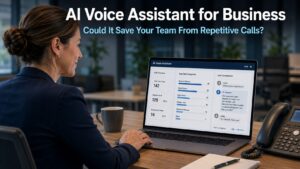
An AI voice assistant for business is attracting genuine interest from owners who are tired of watching their team answer the same questions dozens of times each day. Opening times, appointment availability, order status, callback requests. These are entirely normal enquiries for a caller who does not know the business. However, when the same questions repeat all day, they consume staff time that could be spent on more valuable work. Modern AI voice technology is now capable enough to handle these conversations reliably, and the difference between what is available today and the old press-1-for-sales systems that most people dislike is significant.
How a Modern AI Voice Assistant for Business Actually Works
The phone automation systems that most people associate with frustration worked by routing callers through rigid menus. You pressed a number to indicate your category of enquiry, and the system moved you to a predetermined path. If your question did not fit neatly into one of the options, the system failed, and the caller either hung up or pressed zero hoping to reach a person.
Modern AI voice assistants work differently. Rather than requiring callers to navigate a menu, they allow the caller to explain what they need in their own words. The system listens, understands the request in context, and responds conversationally. The better systems handle natural back-and-forth exchanges rather than a single question-and-answer interaction, and they manage unexpected turns in the conversation without breaking down.
The more capable platforms go further by connecting directly to business systems. Rather than simply answering a question about appointment availability, they can check the calendar, offer specific slots, and book an appointment, all within the same call. They can pull account information, update records, send confirmation messages, and trigger follow-up actions within connected tools. For businesses handling a high volume of routine calls, this kind of end-to-end handling removes a category of work from the team’s queue entirely rather than just reducing the length of the call.
Where an AI Voice Assistant for Business Works Best
The situations where an AI voice assistant delivers the most value share specific characteristics. The enquiries are repetitive and predictable. The information needed to respond is accessible within connected systems. The caller’s need can be met without emotional sensitivity or complex human judgement.
Appointment booking is one of the clearest examples. A caller who wants to check availability and book a slot does not need a person for that transaction. An AI voice assistant that connects to the scheduling system can handle it fully, at any time of day, without keeping a caller on hold or requiring a team member to stop what they are doing.
Basic account queries are another strong fit. Order status, balance enquiries, and account information lookups are tasks where the caller needs a specific piece of information and the system has access to it. The AI retrieves and provides it accurately without any human involvement required.
Overflow handling outside office hours is a third valuable application. Calls that arrive when the team is unavailable are currently either missed or diverted to voicemail. An AI voice assistant can handle these calls, answer common questions, take callback requests with specific details, or book appointments for the following day. The caller gets a useful response. The business captures information that would otherwise have been lost.
For businesses in Haywards Heath and across Sussex that deal with high call volumes during busy periods, the AI can also serve as a first point of contact that handles straightforward enquiries and routes more complex ones to the appropriate person, reducing the pressure on staff during peak times without reducing the quality of the customer experience for callers who need human assistance.
Where Human Judgement Still Matters Most
An AI voice assistant for business works well within its defined scope. It does not work well outside it, and understanding the boundary is as important as understanding the capability.
Emotional or complex calls still require a person. A frustrated customer with a billing dispute, someone dealing with a sensitive personal circumstance, or a caller with an unusual situation that does not match the system’s training all benefit from speaking with a human who can apply context, empathy, and flexible thinking. Routing these calls to AI rather than a person creates a worse experience for the caller and reflects poorly on the business.
The practical approach is to start small. Identify one narrow area where AI can handle calls reliably without risk to the customer relationship. Test that specific application, measure how well it performs, and expand only where the results justify it. Starting with appointment booking or after-hours handling is lower risk than attempting to route all incoming calls through an AI system from day one. This measured approach gives the business room to learn what works without disrupting the customer experience across the board.
Security and Integration Questions That Must Be Answered First
Before deploying an AI voice assistant for business, several important questions need clear answers. These are not minor considerations to address after implementation. They are prerequisites that determine whether the deployment is appropriate and compliant.
Data handling is the most important. An AI voice assistant that accesses customer records, appointment calendars, account information, or internal systems is processing data that may include personal information. Under UK data protection law, this requires clarity about where that data is stored, how it is protected, who has access to it, and what happens to call recordings. Not every platform handles these requirements equally well, and a system that is impressive in a demonstration may not meet the data governance standards your business needs.
Integration quality matters significantly. An AI voice assistant that does not connect properly with the systems your business already uses creates the kind of manual bridging work described in our article on human middleware. The caller gets a response, but someone still has to update the system manually afterwards. That outcome removes much of the value the AI was supposed to deliver.
Real-world performance is a different question from demonstration performance. Systems that work smoothly in ideal conditions can struggle with background noise, unfamiliar accents, industry-specific terminology, or questions that fall slightly outside the expected scope. Testing a platform against the actual conditions it will face in your business is essential before committing to a full deployment. Our article on IT budget pressure and technology decisions covers how to evaluate technology investments based on genuine business fit rather than headline capability.
Our cyber security page covers how data governance considerations extend to AI tools, and our managed IT services include guidance on evaluating and deploying AI tools for businesses across Sussex and the South East.
What This Means For Businesses
An AI voice assistant for business is a genuinely useful tool in the right context. The technology has moved well beyond the rigid menu systems that gave phone automation a poor reputation, and for businesses with high volumes of repetitive, predictable calls, the time savings available are meaningful. Customers get faster responses. Staff are freed from repetitive enquiry handling. The information captured from calls is more consistent and more complete.
The businesses that benefit most start with a clear, narrow application, verify that the platform meets their data handling requirements, and confirm that integration with existing systems is genuine rather than superficial. Those that approach it as a complete replacement for customer contact without addressing these questions tend to find the implementation more complex and less effective than expected.
Final Thoughts
AI voice assistants for business are improving quickly and are already delivering real value for businesses that have matched them carefully to the right applications. The technology will continue to develop over the next few years, and the scope of what it can handle reliably will broaden further.
The starting point is not finding the most capable system available. It is identifying where your team currently handles the most predictable, repetitive calls and asking whether an AI voice assistant could handle those reliably. If the answer is yes, a careful, narrow pilot is the right next step. If the answer requires more thought, that thought is worth taking before committing to a platform.
Traditional phone automation required callers to navigate rigid menus by pressing numbered options. Modern AI voice assistants allow callers to explain their needs in natural language. The system understands the request in context, responds conversationally, and can handle back-and-forth exchanges without breaking down. The better platforms also connect to business systems to complete actions such as booking appointments or checking account information within the call.
Repetitive, predictable enquiries that can be resolved using information held in connected business systems. Common examples include appointment booking, order status enquiries, basic account information requests, and after-hours call handling. Emotional, complex, or unusual calls still require human judgement and should be routed to a person rather than handled by an AI system.
You need to know where customer data and call recordings are stored, how they are protected, who has access to them, and how the system processes information that may be personal data under UK data protection law. Not every platform meets these requirements equally, and this should be assessed before deployment rather than after. Your IT provider can help evaluate whether a specific platform meets your compliance requirements.
Start with one narrow, well-defined application rather than attempting to automate all incoming calls immediately. Appointment booking or after-hours handling are lower-risk starting points. Test the system against the real conditions it will face in your business, including background noise, accents, and common question types. Measure the results before expanding to other areas.
A well-configured AI voice assistant recognises when a call falls outside its defined scope and routes it to a human team member rather than attempting to handle it inadequately. Setting up this fallback correctly is an important part of the deployment. A caller who reaches a dead end because the AI cannot help and does not transfer them to a person will have a poor experience that reflects on the business.


