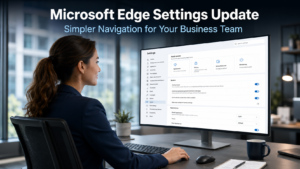
The Microsoft Edge settings update is a practical improvement that addresses a frustration many business users will recognise. Finding the right setting in Edge has not always been straightforward. The settings menu has grown over time, and navigating it to locate a specific option can feel like searching through a cluttered filing cabinet rather than using a well-organised tool. Microsoft is changing this with a redesigned settings layout that makes navigation considerably more intuitive.
What the Microsoft Edge Settings Update Changes
The update introduces two key improvements to how the Edge settings menu is structured and accessed.
The first is a new quick access panel. This appears at the top of the main settings page and provides shortcuts directly to the features and settings that most users are likely to need most often. Rather than scrolling through a long list of options to find something you visit regularly, the quick access panel brings those items to the surface immediately. For staff who adjust browser settings periodically as part of their work, this removes an unnecessary navigation step.
The second improvement is a restructuring of the settings into clearer, more logical submenus. Categories such as System and Performance and Appearance are given their own dedicated sections, each with a clear label and a defined scope. Finding the setting you need becomes a matter of identifying the right category and navigating to it directly, rather than searching through a broad and undifferentiated list.
These submenus also receive their own quick access shortcuts. This means that once a user is within a specific category, the most commonly used options within that category are equally easy to reach. The consistency of this approach across the whole settings experience is what makes the update feel coherent rather than piecemeal.
Why This Matters for Business Teams
For most team members, adjusting browser settings is an occasional rather than daily task. However, when it is necessary, the experience of navigating an unclear menu structure adds friction to what should be a straightforward activity. A team member who cannot quickly find the privacy setting they need, the download location they want to change, or the accessibility option that helps them work more comfortably, is spending time on navigation that should be spent on their actual work.
The cumulative effect of small friction points like this across a team is easy to underestimate. Settings that feel difficult to find tend to stay unconfigured. Preferences that would improve the working experience go unset because the effort of locating the right option outweighs the perceived benefit. A cleaner settings structure removes this barrier and makes it more likely that Edge is configured to work well for each person using it.
For businesses in Brighton and across Sussex that use Microsoft Edge as their standard business browser, this update makes the tool more accessible and easier to manage. It also removes one of the comparative disadvantages that Edge has historically carried relative to Google Chrome, which has been consistently praised for the organisation and clarity of its settings interface.
Is Now a Good Time to Use Edge as Your Business Browser?
Microsoft has been investing steadily in Edge as a business browser, and the settings update is one improvement among several. Edge already includes a useful reading mode for longer documents, strong integration with Microsoft 365 and SharePoint, built-in PDF tools, and the Copilot AI sidebar. The privacy and security settings are well-developed and appropriate for business use.
For businesses whose teams are still using Google Chrome as their default browser, this settings update is a reasonable prompt to evaluate whether Edge might now be worth switching to. The practical differences between the two browsers for everyday business use are not large, and the tighter integration between Edge and the rest of the Microsoft ecosystem may be genuinely useful for businesses that are already invested in Microsoft 365.
Our article on Microsoft Copilot in Edge covers how AI features are being built directly into the browser, which is another reason the platform is becoming an increasingly capable business tool. Our Incognito mode privacy update article covers another recent browser privacy improvement relevant to business users.
When the Update Arrives and What to Expect
Microsoft is currently testing the settings update before rolling it out more widely. This is standard practice for Edge improvements, which go through a testing phase before reaching all users. Once the update reaches general availability, it will arrive through the normal Edge update process without any action required from businesses or their IT teams.
Edge updates automatically for most business configurations, which means this improvement should reach your team’s devices without anyone needing to do anything specific. If your business manages browser updates centrally through your IT infrastructure, your IT provider can confirm when the update will be applied across your devices.
The transition to the new settings layout should be seamless. Users who are familiar with the current settings structure will find that the new layout is easier to use rather than confusingly different. There is no significant relearning involved, just a more organised version of the same menu.
What This Means For Businesses
The Microsoft Edge settings update is a focused and practical improvement. It does not change how Edge works or what it can do. It simply makes the settings that govern how it works easier to find and manage. For business teams that use Edge regularly, this is a quality-of-life improvement that reduces friction without requiring any adjustment in how people work.
For business owners and directors, the update requires no specific action. It will arrive automatically and improve the Edge experience without any intervention needed. If your business has not reviewed whether Edge is fully configured to suit your team’s needs, the cleaner settings interface makes this a more straightforward task than it has been previously.
If your business uses a managed IT provider, the update will be applied as part of routine browser management. Our managed IT services include browser configuration and management for businesses across Sussex and the South East, ensuring your team’s browsers are kept current and configured appropriately.
Final Thoughts
The Microsoft Edge settings update is the kind of improvement that makes everyday use of a tool slightly smoother without requiring any effort from the people using it. A clearer settings menu, better-organised categories, and quick access shortcuts collectively make Edge more practical to configure and manage.
For businesses already using Edge, this is a welcome refinement. For those still on Chrome, it is a further reason to reconsider whether Edge might now be the better fit for a team operating within the Microsoft 365 ecosystem.
Microsoft is redesigning the settings menu in Edge to make it easier to navigate. The update introduces a quick access panel at the top of the settings page for commonly used options, and reorganises settings into clearly labelled submenus such as System and Performance and Appearance, each with their own shortcuts. The result is a settings experience that is significantly easier to navigate than the current layout.
Microsoft is currently testing the update before rolling it out to all users. Once it reaches general availability, it will arrive through the standard Edge update process automatically. For most business configurations, no manual action is required to receive the update.
No significant relearning is required. The update reorganises and simplifies the settings rather than replacing them with an unfamiliar structure. Users who are accustomed to the current settings will find the new layout easier to use rather than confusingly different. The quick access panel will make frequently needed settings immediately visible.
This depends on your current setup and preferences. Edge and Chrome are broadly comparable in everyday use. However, for businesses invested in Microsoft 365, Edge offers tighter integration with Teams, SharePoint, OneDrive, and the Copilot AI assistant. If your team primarily uses Microsoft applications, Edge may offer a more cohesive experience than Chrome. The settings update removes one of Edge’s previous comparative disadvantages and makes it a more competitive option.
The cleanest approach is to work with whoever manages your IT to review Edge’s settings against your business requirements. Key areas to check include privacy and security settings, extension management, download location defaults, and whether Edge’s Microsoft 365 integrations are enabled. A managed IT provider can configure Edge consistently across all your team’s devices as part of standard device management.