Opening a PDF from Outlook or Teams feels harmless. It is something most of us do many times a day. Unfortunately it has also become one of the easiest ways for criminals to sneak malware into your business.
In this article we will look at how to safely open PDF attachments in Outlook and Teams, what the real risks are, and the practical steps you can take so your team in Sussex, Surrey or across the South East can work confidently without constant fear of clicking the wrong thing.
Why you need to safely open PDF attachments in Outlook and Teams
PDFs are popular with attackers because people trust them. Staff expect invoices, contracts, reports and statements to arrive as PDF files. That makes it more likely someone will open a malicious file without thinking twice.
Criminals now routinely:
- Send fake invoices or statements as PDFs that contain hidden malware
- Use PDF links to take people to phishing websites that steal passwords
- Exploit weaknesses in old PDF readers to run malicious code
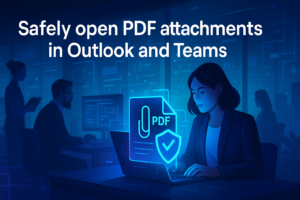
Because Outlook and Teams are at the heart of day to day work, they are prime delivery channels. Learning how to safely open PDF attachments in Outlook and Teams is therefore a simple but important part of protecting your business.
Common PDF risks in Outlook and Teams
Not every PDF is dangerous. The risk comes from a few specific tricks that attackers use.
Malicious links inside the PDF
A PDF can contain clickable links. These links might:
- Look like they go to a known supplier or bank
- Actually point to a fake login page controlled by criminals
- Capture passwords or card details as soon as you type them
Staff often assume that if the PDF opened, it must be safe. That is not the case. You still need to treat links inside the PDF with the same caution as links in an email.
Embedded scripts and exploits
Some PDFs contain embedded code. On an unprotected or out of date device this can allow malware to run automatically when the file opens.
This is more likely to succeed if:
- Your PDF reader is old and has not been updated
- You are using unsupported Windows versions or outdated browsers
- Devices do not have up to date security tools
Social engineering around urgent documents
Attackers know that people rush when something feels urgent. They may send a PDF that appears to be:
- An overdue invoice from a supplier
- A legal notice or compliance letter
- A revised contract that needs signing today
The text in the email or Teams message pushes people to open the file quickly, before they stop to think.
How Outlook and Teams handle PDFs by default
Microsoft has added helpful features over the years, but it is important to understand their limits.
Previewing PDFs in Outlook
When you click a PDF in Outlook, you may see a preview in the reading pane. This is convenient, but it is not a guarantee of safety. Outlook will still pass the file to a PDF viewer on your device or in the browser.
If that viewer is not fully patched, a malicious PDF can still cause harm.
Opening PDFs in Teams
Teams often opens PDFs directly in the built in viewer or in your browser. Again, this is mainly for convenience. It does not automatically strip out all possible threats.
In both Outlook and Teams you should think of previews as a way to see the content more easily, not as a safety check.
Practical steps to safely open PDF attachments in Outlook and Teams
You do not need to turn your business upside down to reduce risk. A few simple habits and settings can make a big difference.
1. Train people to pause before they click
Encourage your team to make three quick checks before opening any PDF:
- Do I recognise the sender and was I expecting this document
- Does the message sound like them or does the tone feel odd or urgent
- Is the file name sensible or is it vague such as document123.pdf
If anything feels off, they should not open the attachment. Instead they should contact the sender using a known phone number or a fresh email, not by replying directly to the suspicious message.
For more on spotting suspicious messages you may find our guide on what every small business should know about phishing helpful.
2. Keep PDF readers and browsers fully updated
Many PDF attacks rely on old software. Make sure that:
- Windows and macOS updates are installed promptly
- Browsers such as Edge, Chrome or Firefox are kept current
- Any standalone PDF reader is on the latest supported version
If you use managed devices, your IT partner can usually automate this so staff do not have to think about it.
3. Use built in protection in Microsoft 365
If your business uses Microsoft 365 Business Premium or certain Enterprise licences, you can enable extra protection that helps you safely open PDF attachments in Outlook and Teams.
These features can:
- Scan attachments for known malware before they reach inboxes
- Open suspicious files in a secure container so they cannot reach the rest of the device
- Block or warn on PDFs that contain risky links
Your IT support provider can tell you which features you already have and which may be worth adding.
4. Consider opening unknown PDFs in a safer environment
For particularly sensitive roles such as finance or HR, you may want an extra layer of caution.
Options include:
- Opening unknown PDFs on a separate, locked down device that holds no critical data
- Using a virtual desktop or secure browser session for high risk tasks
- Printing and reviewing on paper if the content is short and does not contain links
These approaches are not needed for every user, but they can reduce risk in key areas.
5. Strengthen your overall email and collaboration security
PDFs are just one route in. If your wider security is weak, attackers will try other methods too.
At a minimum you should:
- Use multi factor authentication on all Microsoft 365 accounts
- Have a reliable backup of email and files stored separately from your main systems
- Run up to date endpoint protection on all company devices
The UK National Cyber Security Centre has clear advice for small and medium sized organisations on basic controls that make a big difference. You can read more on the NCSC small business guide.
How to talk to your team about PDF safety without scaring them
People in your business need to feel confident using Outlook and Teams. Constant warnings can make them nervous and slow everything down.
When you explain how to safely open PDF attachments in Outlook and Teams, keep the message simple:
- Most PDFs from known contacts are fine
- We just want you to pause and check when something is unexpected or urgent
- If in doubt, ask. You will never be blamed for double checking
Short, regular reminders tend to work better than long, one off training sessions. You could add a simple checklist to your staff handbook or intranet and mention it in team meetings.
What this looks like in a typical UK business
Imagine a small accountancy firm in Surrey. The team receive dozens of PDF invoices and statements every day through Outlook and Teams. They do not have time to treat every file as a major event.
By putting a few basics in place they can lower risk without creating friction:
- Microsoft 365 attachment scanning is turned on
- Devices are kept fully patched and use modern browsers
- Staff know to be wary of unexpected or urgent PDFs, especially about payments
- High risk documents are opened in a secure environment first
The result is a sensible balance. People can get on with their jobs while the most common attack routes are covered.
How My Tech Team can help
If you are not sure whether you are set up to safely open PDF attachments in Outlook and Teams, it can be hard to know where to start. Settings are scattered across Microsoft 365, devices and security tools, and it is easy to miss something important.
We can review how your business currently handles email and Teams attachments, check your Microsoft 365 protection, and suggest practical changes that fit the way your team works. That might include tightening scanning rules, improving updates, or adding simple training for staff.
If you would like to talk it through, you can book a short, no obligation call at a time that suits you using our online calendar: schedule a 30 minute chat.