Windows 11 natural language search is coming, and for businesses that spend any amount of time hunting for files across shared drives and project folders, it represents a genuinely useful step forward. Microsoft is introducing the ability to search for files using plain, conversational descriptions rather than needing to remember an exact file name. The change sounds simple. In practice, it could save your team a noticeable amount of time every single working day.
What Windows 11 Natural Language Search Actually Does
Most people have experienced the frustration of knowing a file exists but being unable to locate it through search. You remember writing the document. You have a rough idea of when. However, the exact file name escapes you. Standard Windows search requires fairly precise terms to return useful results. It often surfaces web links or unrelated documents instead of the file you need.
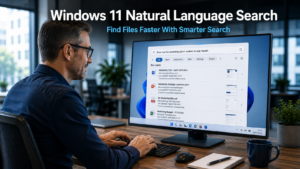
Windows 11 natural language search changes this approach entirely. Rather than typing an exact file name or keyword, you describe what you are looking for in plain English. Something like “the notes from the July project meeting” or “the proposal I worked on last month for the Brighton client”. Windows understands the intent behind the description and returns relevant results accordingly.
This shift from exact keyword matching to conversational understanding is powered by artificial intelligence running directly on the device. The result is a search experience that feels far more intuitive than what most business users are currently used to.
Windows 11 Natural Language Search and Copilot+ PCs
There is an important caveat. Windows 11 natural language search is not available on every computer running Windows 11. The feature requires what Microsoft calls a Copilot+ PC.
Copilot+ PCs are a newer category of computers built with a specific type of processor called an NPU, which stands for Neural Processing Unit. This chip handles AI tasks locally on the device rather than sending data to an external server. The result is faster processing and, importantly, greater privacy for the files and queries involved.
If your current business computers were purchased before this hardware generation, they will not support this feature. The natural language search update will not appear on standard Windows 11 devices, regardless of how recently they were purchased, unless they include the required NPU hardware.
This is not a reason to dismiss the feature. However, it does mean that businesses planning hardware refresh cycles should factor Copilot+ compatibility into their decisions. Our article on the Windows 11 upgrade covers the broader hardware considerations for businesses reviewing their devices.
How the Feature Works With OneDrive
For businesses already using OneDrive as part of Microsoft 365, the natural language search feature becomes even more useful. The search function extends beyond locally stored files to include documents held in OneDrive cloud storage.
This means a team member can search for a file using a plain description and retrieve results from both their local drive and their cloud storage in a single search. For businesses where staff work across multiple devices or regularly access shared files from different locations, this level of integration reduces the time spent navigating between different storage locations.
Furthermore, this integration reinforces the value of using OneDrive consistently as your business file storage platform. Files stored in OneDrive become discoverable through the new search, while files scattered across email attachments, desktop folders, or external drives remain harder to find. Our cloud management page explains how businesses can use OneDrive and Microsoft 365 more effectively across their teams.
What This Means for Day-to-Day Productivity
The cumulative time cost of searching for files is easy to underestimate. A team member who spends two or three minutes finding the right document several times each day loses a meaningful amount of productive time across a week. Multiply that across a team of ten, and the figure becomes significant.
Natural language search reduces this friction. It removes the need to remember exact file names, navigate folder structures, or scroll through lists of search results hoping to spot the right document. The staff member describes what they need and Windows finds it.
For businesses in Burgess Hill and across Sussex managing multiple ongoing projects with large numbers of documents, this kind of improvement has a practical impact that goes beyond convenience. Less time spent on administration leaves more time for the work that actually moves the business forward.
This sits alongside other Windows 11 productivity improvements Microsoft has been rolling out. Our article on Windows 11 Start menu improvements covers another recent update that makes everyday tasks more efficient for business users.
The Bigger Picture: AI Built Into Business Hardware
Windows 11 natural language search is one feature within a broader shift in how Microsoft is integrating artificial intelligence into everyday business tools. Copilot, Microsoft’s AI assistant, is already embedded in Windows 11 and Microsoft 365. It helps with drafting documents, summarising emails, generating content, and now finding files through conversational search.
Copilot+ PCs are the hardware platform designed to run these AI features locally and efficiently. As Microsoft adds more AI-powered capabilities to Windows 11 and Microsoft 365, the advantage of having compatible hardware increases. Businesses that invest in Copilot+ PCs now are positioning themselves to benefit from a growing range of features as they roll out.
This does not mean every business should rush out and replace all their computers. Hardware decisions should always be based on genuine business need and planned budgets. Nevertheless, understanding what the new hardware enables is useful context when those decisions arise.
What This Means For Businesses
Windows 11 natural language search is currently in testing and limited to Copilot+ hardware. Most businesses will not see it appear on their existing devices. However, it signals a clear direction of travel for Microsoft and for the capabilities that will become standard in business computing over the next few years.
For business owners and directors, the practical consideration is straightforward. If your business is planning to refresh hardware in the coming months, it is worth understanding which devices qualify as Copilot+ PCs and what features that unlocks. Making informed hardware decisions now avoids finding out after purchase that the latest features are unavailable.
If your team is already on Windows 11 with compatible hardware, keep an eye on your Windows updates. The natural language search feature is progressing through testing and a broader rollout is expected. When it arrives, a brief introduction to how it works will help your team adopt it quickly and get immediate benefit from it.
Our managed IT services include hardware planning and device management for businesses across Sussex and the South East, helping you make technology decisions that reflect where your business is heading rather than just where it is today.
Final Thoughts
Windows 11 natural language search solves a problem that most business users encounter regularly. Finding files should not require remembering exact names or manually navigating folder structures. Describing what you need in plain English is a more natural approach, and the technology to support it is now arriving.
The feature will not reach every business immediately. However, it is a meaningful indicator of how Windows 11 continues to develop. Businesses that stay on supported, up-to-date hardware will increasingly benefit from these improvements as they roll out.
It is a new search feature that allows Windows 11 users to find files by typing a plain English description rather than an exact file name. For example, typing a description of a document by topic, date, or context returns relevant results. The feature uses AI to understand the intent behind the search rather than matching exact keywords.
No. The feature requires a Copilot+ PC, which is a computer built with a Neural Processing Unit, or NPU. This is a specialist processor designed to handle AI tasks locally on the device. Computers that do not include this hardware will not support the feature, regardless of which version of Windows 11 they run.
A Copilot+ PC is a category of computer built to run Microsoft’s AI-powered features, including natural language search and the Copilot assistant, efficiently and privately on the device itself. Whether your business needs one depends on your hardware refresh plans and how useful these AI features would be for your team. They are worth considering if you are planning to replace devices in the near future.
Yes. The feature extends to files stored in OneDrive as well as those saved locally on the device. This means users can search across both local and cloud storage using a single conversational description, which is particularly useful for businesses that store files in OneDrive as part of a Microsoft 365 setup.
The feature is currently in testing through preview builds of Windows 11 for Copilot+ devices. A broader rollout is expected to follow. For compatible hardware, the update should arrive through the standard Windows update process without any manual action required.