The Windows 11 upgrade benefits are clear, the deadline for Windows 10 support has now passed, and the majority of businesses that were still running Windows 10 were sitting on hardware that could have upgraded at no additional cost. Research of over 750,000 Windows 10 systems found that 88% of them were fully capable of running Windows 11. Yet before the October 2025 end-of-support deadline, more than eight in ten businesses had still not made the move. Understanding what held them back, and what those that have upgraded have gained, is useful context for any business still navigating this transition.
Why So Many Businesses Delayed the Windows 11 Upgrade
The most common reason businesses delayed upgrading was concern about disruption. Changing an operating system across a business feels like a significant undertaking. There are natural worries about downtime, about staff needing to relearn how things work, about applications behaving differently, and about technical problems emerging at inconvenient moments.
These concerns are understandable. However, for the majority of businesses, they significantly overstate the difficulty of a well-managed upgrade. The transition from Windows 10 to Windows 11 is not the kind of wholesale change that earlier Windows upgrades sometimes involved. Most applications continue to work. Most workflows remain the same. The visible differences are largely navigational, and most staff adapt within a day or two.
The irony is that the disruption of continuing to run Windows 10 beyond its end-of-life date is likely to be considerably greater than the disruption of a planned, properly managed upgrade. A device running unsupported software is a device that grows progressively more vulnerable to attack. A successful cyber attack or ransomware incident causes far more disruption than any upgrade process.
The Windows 11 Upgrade Benefits Your Business Gains
The case for upgrading is not only about avoiding the risks of staying on Windows 10. There are genuine and meaningful benefits that Windows 11 delivers to businesses that make the move.
Security is the most important. Windows 11 was built with modern threats in mind. It includes stronger default protections against ransomware, better credential security, and more robust defences against the types of attack that businesses encounter most frequently. These are not marginal improvements. They reflect a meaningful step forward in how the operating system protects the devices it runs on.
Performance is another Windows 11 upgrade benefit worth noting. Windows 11 makes better use of available hardware resources, which means devices often feel more responsive after the upgrade, particularly on machines that were starting to feel sluggish under Windows 10. For teams that spend all day on their computers, this translates directly into a smoother and less frustrating working experience.
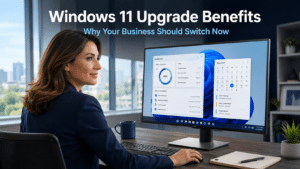
The interface is cleaner and more intuitive. The taskbar redesign, improved window management through Snap Layouts, and better integration between applications make the day-to-day experience of using the computer feel more organised and efficient. For most staff, these changes are minor adjustments rather than significant relearning. Within a day or two, the new interface feels natural.
Integration with Microsoft 365 tools improves on Windows 11. Teams, OneDrive, Outlook, and the broader Microsoft 365 suite all work more cohesively within the Windows 11 environment. For businesses that rely on these tools daily, the improvement is genuinely noticeable. Our cloud management page covers how to get the most from Microsoft 365 across your team.
Windows 11 Upgrade Benefits Include Access to AI Features
One of the most significant Windows 11 upgrade benefits is access to the growing range of AI-powered features Microsoft is building into the operating system. These include natural language search, voice dictation with AI clean-up, screen privacy detection, and deeper integration with Microsoft Copilot across applications.
None of these features are available on Windows 10. As Microsoft continues to invest in AI capabilities within Windows 11, the gap between what Windows 10 and Windows 11 offer will widen. Businesses that remain on Windows 10 are not simply running older software. They are progressively falling further behind in terms of the tools available to their teams.
Some of the most capable AI features require not just Windows 11 but Copilot+ hardware with specialist processors. However, the broader range of Copilot and AI features within the standard Windows 11 experience are available on any compatible device. Our article on Windows 11 natural language search covers one example of what is now available to businesses running Windows 11.
Is the Upgrade Free and How Easy Is It?
For most businesses running Windows 10 on compatible hardware, the upgrade to Windows 11 is free. The operating system upgrade itself does not require a new licence purchase. The only cost involved is the time and expertise required to manage the upgrade process, and for hardware that does not meet Windows 11 requirements, the cost of replacement devices.
The upgrade process itself, for compatible hardware, is straightforward. Microsoft has designed it to minimise disruption. Applications, files, and settings carry across from Windows 10. Staff return to a familiar environment with a cleaner interface rather than an unfamiliar one. The adjustment period is short for most users.
Where hardware replacement is required, those decisions are more involved. However, new hardware running Windows 11 also means better performance, longer device lifespan, and access to the latest security and AI capabilities. For businesses planning a device refresh, the investment is worthwhile on multiple grounds.
Our article on the Windows 11 upgrade and business planning covers what the process involves and how to approach it for businesses of different sizes and setups.
What This Means For Businesses Still on Windows 10
For businesses that have not yet completed their upgrade to Windows 11, the situation following the October 2025 end-of-support date is straightforward. Windows 10 devices are now running unsupported software. Microsoft will not release further security patches for them. Every week that passes increases the exposure those devices carry.
The Windows 11 upgrade benefits are not future possibilities. They are available now, on compatible hardware, at no software licence cost. The obstacles that held many businesses back, concern about disruption and unfamiliarity, are significantly smaller in practice than they appeared in prospect.
For business owners and directors across Sussex and the South East, the priority is to complete the transition as quickly as possible for any devices still running Windows 10. A managed IT provider can assess your current hardware, manage the upgrade process across your devices, and ensure the transition happens with minimal impact on daily operations. Our managed IT services include Windows 11 upgrades and device management for businesses across the region.
Final Thoughts
The Windows 11 upgrade benefits are real, available, and in most cases free for businesses on compatible hardware. Better security, improved performance, a cleaner interface, tighter Microsoft 365 integration, and access to a growing range of AI features all come with the upgrade. The risks of remaining on Windows 10 are equally real and growing with each passing week.
If your business has not yet completed this transition, now is the time to make it happen. The window for doing so in a planned, unhurried way is still open. The alternative, continuing to run unsupported software indefinitely, is not a viable long-term position.
For most businesses running Windows 10 on hardware that meets Windows 11 requirements, the operating system upgrade itself is free. There is no new licence to purchase. Costs arise if some devices need to be replaced because they do not meet Windows 11 hardware requirements, and from the time and expertise required to manage the upgrade process across your team.
The vast majority of modern business applications work without issue on Windows 11. Older or specialist software occasionally requires testing or updating. It is worth checking compatibility for any business-critical applications before beginning, particularly industry-specific tools that may not have been updated recently. Your IT provider can carry out this check as part of the upgrade planning process.
Most people adapt within one to two days. The core experience of using Windows is familiar. The main adjustments are navigational: the centred taskbar, the repositioned Start menu, and some changes to where settings and features are found. A brief introduction to these changes before the upgrade helps staff settle in faster and reduces the number of support queries immediately after the switch.
Devices that do not meet Windows 11 hardware requirements cannot be upgraded directly. For these machines, replacement is the appropriate path. A hardware assessment from your IT provider will identify which devices can upgrade and which need replacing, allowing you to plan costs and prioritise replacement decisions appropriately.
A managed IT provider can carry out a hardware compatibility assessment, manage the upgrade process across all devices with minimal disruption, handle any necessary device replacements, provide staff with a brief introduction to the new interface, and ensure all applications and settings carry across correctly. For businesses without dedicated internal IT resource, this removes the complexity and risk from the transition entirely.