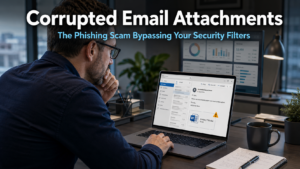
Corrupted email attachments have become the latest weapon in the phishing armoury, and they are catching businesses off guard. An employee spots an email with a Word document attached. It looks like an invoice, a delivery notice, or a message from a supplier. They open it. Seconds later, they have handed cyber criminals a route straight into the business. This scam is specifically designed to bypass the security tools your email platform uses, which makes it harder to detect and more dangerous than most.
How Corrupted Email Attachments Work
Email security filters scan incoming attachments for threats. They analyse files for malicious code, suspicious links, and known attack signatures. Most of the time, this process catches harmful content before it reaches an inbox.
This scam exploits one specific weakness in that process. When a file is deliberately corrupted, security filters cannot analyse it properly. The file appears damaged rather than dangerous. As a result, it passes through the filter and lands in the recipient’s inbox without triggering any alerts.
When the recipient opens the file, Microsoft Word attempts to repair it automatically. This is normal behaviour. Word is designed to recover damaged documents. The document then opens and appears to show a legitimate attachment, perhaps a payslip, a form, or a business document.
Hidden within it, however, is a malicious QR code or a link. Both lead to a fake login page, typically designed to look like the Microsoft 365 sign-in screen. Anyone who enters their credentials on that page hands their account details directly to the attacker.
Why Corrupted Email Attachments Are Particularly Effective
Several factors make this attack more effective than many others.
First, it bypasses automated defences. Security filters that would catch a conventional phishing link have no way to scan a file they cannot open. The corrupted attachment therefore arrives with no warning attached to it, giving the recipient no technical signal that anything is wrong.
Second, the file appears normal once opened. Word repairs it silently and displays content. There is no obvious error, no garbled text, and no visible sign of tampering. The document looks like what the email claimed it was.
Third, the Microsoft 365 login page used in these attacks is frequently a convincing replica. Staff who see a familiar login screen naturally assume they need to re-authenticate before accessing the document. Entering credentials feels routine rather than suspicious.
For businesses across Sussex with staff who handle a high volume of email daily, the conditions for this type of scam to succeed are common. Busy inboxes, time pressure, and a document that looks entirely plausible create exactly the circumstances attackers rely on.
What Happens If an Attacker Gains Access
A single compromised login credential opens more doors than many people realise.
With access to a Microsoft 365 account, an attacker can read and export emails, access shared files and client data, and move through connected systems. They can lock the business out of documents by changing permissions. They can send phishing emails from the compromised account to the victim’s own contacts, exploiting the trust those contacts place in a familiar sender.
The consequences extend beyond immediate data loss. Regulatory obligations under UK data protection law require businesses to report breaches involving personal data within 72 hours. A breach that goes undetected for days or weeks, which is common when credentials are stolen rather than systems locked, can result in significant regulatory consequences in addition to the direct damage.
Reputational harm can persist long after the technical incident is resolved. Clients and partners who receive phishing emails apparently from your account lose confidence. Rebuilding that trust takes time and effort. Our cyber security page covers how a structured approach to protection helps businesses manage these risks before incidents occur.
How to Protect Your Business from Corrupted Email Attachments
Technical defences alone cannot fully protect against this attack, because the scam is specifically designed to evade them. Staff awareness therefore becomes the critical layer of protection.
The most effective habit is simple: pause before opening any attachment. Ask whether the email was expected. Consider whether the sender is someone you know. Check whether the context makes sense. An invoice from a supplier you have never dealt with, or a document that arrives without any prior communication, deserves closer scrutiny before being opened.
Urgency is a reliable warning sign. Attackers frequently write emails that create pressure to act immediately, before the recipient has time to think carefully. Any email that demands quick action around a financial matter, a login issue, or an urgent document should prompt extra caution rather than a fast response.
If an email looks genuine but something feels slightly off, verify it directly. Contact the sender through a known phone number or a separate email, not by replying to the suspicious message. A legitimate sender will always be able to confirm whether they sent the attachment.
Multi-factor authentication provides a vital backstop even when credentials are compromised. If a staff member enters their details on a fake login page, multi-factor authentication means those credentials alone are not enough for the attacker to access the account. A second verification step, such as a code sent to a mobile phone, blocks entry. Our article on strengthening your business security explains how to implement this across your team.
Regular staff training reinforces these habits. Phishing tactics evolve constantly, and a team that receives periodic updates about emerging techniques is far better placed to recognise them. Our article on employee cyber security explores how to build this kind of awareness into everyday working practices.
What This Means For Businesses
Corrupted email attachments represent a clear example of how attackers adapt their methods to overcome defences. As security tools improve, so do the techniques designed to bypass them. Businesses that rely solely on technical protection, assuming that security filters will catch everything, are exposed to exactly this kind of threat.
For business owners and directors, the practical implication is straightforward. Make sure your team knows this type of attack exists. Explain the specific tactic: a Word file arrives, Word repairs it, a fake login page appears. When staff recognise the pattern, they are far less likely to fall for it.
Similarly, confirm that multi-factor authentication is active on all Microsoft 365 accounts across your business. This single measure dramatically reduces the impact of a successful credential theft. Combined with staff awareness, it creates a genuinely strong defence against this type of attack.
If your business handles sensitive client data or operates in a regulated sector, the stakes are particularly high. A managed IT provider can help ensure your protections are appropriate, your staff are regularly briefed, and your response plan is ready if an incident occurs. Our managed IT services include ongoing security management for businesses across East Grinstead and the wider Sussex area.
Final Thoughts
Corrupted email attachments are a clever and effective scam precisely because they feel so ordinary. A familiar file type, a routine login prompt, and a small moment of inattention are all it takes. Understanding how the attack works removes much of its power.
Slow down before opening unexpected attachments. Treat urgency in emails as a warning rather than a reason to act. Confirm anything unusual before acting on it. These simple habits, combined with multi-factor authentication, give your business a strong defence against one of the more sophisticated phishing techniques in use today.
Most phishing attacks rely on links or conventional attachments that email security filters can scan. Corrupted files cannot be analysed by standard filters, so they bypass automated defences entirely. The file then appears normal once opened, giving the recipient no obvious indication that anything is wrong before the damage is done.
There is often no obvious visual sign before opening. The key is to assess the email itself. Was it expected? Does the sender seem legitimate? Does the request make sense given your existing relationship with that person or company? If anything feels unusual, verify with the sender directly before opening any attachment.
They should stop immediately and not enter any credentials on any page the file may have opened. They should report the incident to whoever manages IT in your business as quickly as possible. If credentials were entered on a fake login page, those passwords should be changed immediately and your IT team should review account activity for any signs of unauthorised access.
Multi-factor authentication significantly reduces the risk. Even if an attacker captures login credentials through a fake page, they cannot access the account without the second verification factor. It does not make the attack impossible, but it removes most of the value an attacker gains from a stolen password and is one of the most effective protections available.
Yes. A clear and easy reporting process encourages staff to flag suspicious emails rather than ignore them or act on them without checking. This provides early warning of an attempted attack and allows your IT team to alert the rest of the business quickly. Microsoft 365 includes built-in tools for reporting suspicious messages directly from Outlook.