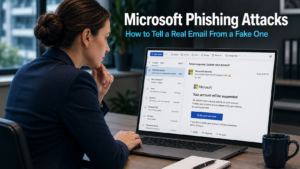
Microsoft phishing attacks have become the single most common form of brand-impersonation fraud targeting businesses worldwide. New research from early 2025 found that more than a third of all brand-related phishing attempts were impersonating Microsoft. Google and Apple appeared further down the same list, with the three tech giants together accounting for more than half of all brand-based phishing scams. For businesses that use Microsoft products every day, understanding what a fraudulent Microsoft email looks like is now an essential part of staying secure.
Why Microsoft Is the Most Impersonated Brand in Phishing Attacks
The reason Microsoft tops the list is straightforward. It is one of the most widely used technology platforms in the world. Microsoft 365, Outlook, Teams, OneDrive, and Azure are used by businesses of every size across every sector. A phishing email that claims to be from Microsoft lands in an inbox where the recipient almost certainly does have a Microsoft account, which immediately makes the message feel relevant and credible.
Attackers follow volume. The more widely a brand is trusted and used, the larger the pool of potential victims for a campaign that impersonates it. When a phishing email claims your Microsoft account requires urgent attention, the recipient does not need to wonder whether they have an account. They almost certainly do. That familiarity reduces scepticism and increases the chance of someone clicking before they think carefully.
The trend extends beyond Microsoft. Mastercard has seen a recent increase in phishing campaigns using fake websites that closely mimic its payment pages, tricking people into entering card details. The pattern is consistent: the more trusted the brand, the more attractive it becomes as cover for a fraudulent campaign.
What Microsoft Phishing Attacks Look Like Today
The days of obvious phishing emails, with poor spelling, mismatched fonts, and generic greetings, are largely behind us. Modern Microsoft phishing attacks are considerably more sophisticated.
Attackers now replicate Microsoft’s branding accurately. Logos, colour schemes, email formatting, and even the specific fonts used in genuine Microsoft communications appear in fraudulent messages. The visual experience of opening a fake Microsoft email and a genuine one can be almost identical.
Sender address spoofing adds further credibility. The displayed name in an email can be set to anything the sender chooses, meaning a fraudulent email can appear in your inbox labelled as “Microsoft Account Team” or similar. The actual sending domain may be slightly different from the genuine one, but many recipients do not check this closely. A domain like “micros0ft.com” or “microsoft-support.net” can pass a quick glance without raising suspicion.
Fake websites used in these attacks are equally convincing. Attackers build replica Microsoft login pages that look and behave exactly like the real thing. A staff member who clicks a link in a fraudulent email and lands on one of these pages may have no reason to question what they are looking at, until they have entered their credentials and handed them to an attacker.
Our article on phishing scams tripling covers the broader rise in phishing frequency and why click rates have increased so sharply in recent years.
How to Spot a Fake Microsoft Email
Recognising Microsoft phishing attacks requires slowing down rather than reacting on instinct. Several specific checks help identify fraudulent messages before any harm is done.
Urgency is the most reliable warning sign. Genuine Microsoft communications do not pressure recipients to take immediate action under threat of consequences. Messages claiming your account will be suspended, your data will be lost, or that you must click a link within a short timeframe are almost always fraudulent. The pressure is designed to prevent careful thinking. Slowing down rather than speeding up is the appropriate response.
Check the sender address carefully, not just the displayed name. Click on or hover over the sender field to reveal the actual email domain. A genuine Microsoft email will come from a microsoft.com domain. Any variation, including additional words, different characters, or an entirely different domain, indicates a fake. This single check catches a large proportion of phishing attempts.
Do not click links directly from emails you were not expecting. If an email claims there is an issue with your Microsoft account, open a browser and navigate directly to microsoft.com by typing the address manually. Log in from there and check whether there is any notification about the issue mentioned in the email. If there is nothing, the email was fraudulent. This approach works regardless of how convincing the email looks.
Attachments in unexpected emails from Microsoft should not be opened. Microsoft does not routinely send executable files, compressed archives, or unusual document types via unsolicited email. Any attachment of this kind in a message claiming to be from Microsoft warrants immediate caution.
Technical Protections That Reduce the Risk
Staff awareness is essential, but it works most effectively alongside appropriate technical measures. These operate independently of whether a team member recognises an attack in the moment.
Multi-factor authentication is the most important technical protection available for Microsoft accounts. Even when a staff member’s credentials are captured on a fake login page, multi-factor authentication means the attacker cannot use them without the additional verification step. The compromised password alone grants no access. Our article on strengthening your business security explains how to implement this across your organisation.
Email filtering tools reduce the volume of phishing messages that reach inboxes in the first place. Well-configured filters identify suspicious sender domains, flag emails with unusual formatting, and block known malicious links before they are clicked. No filter catches everything, but reducing the number of attempts that reach your team lowers overall risk significantly.
Reviewing your Microsoft 365 security settings is also worth considering. Default configurations are not always optimised for security, and a review by a managed IT provider can identify settings that would better protect your accounts from phishing-related compromise. For businesses in Haywards Heath and across Sussex, our managed IT services include Microsoft 365 security configuration as part of ongoing account management.
What This Means For Businesses
Microsoft phishing attacks are the most common form of brand impersonation scam businesses face, and they are growing more convincing. The combination of accurate branding, spoofed sender addresses, and replica login pages means that even careful staff can be deceived without specific knowledge of what to look for.
For business owners and directors, the practical response is clear. Make sure your team knows that Microsoft phishing attacks are the most frequent scam they are likely to encounter. Brief them on the specific checks that identify fake emails. Confirm that multi-factor authentication is active on all Microsoft accounts. And ensure that email filtering is in place and properly configured.
None of these steps requires significant investment. Together, they address the most common attack vector targeting businesses that use Microsoft products every day.
Final Thoughts
Microsoft phishing attacks succeed because they exploit a trusted relationship that almost every business already has. The defence is not to distrust Microsoft, but to pause before acting on any unexpected email that claims to be from them.
Slow down. Check the sender address. Navigate directly to the site rather than clicking links. And ensure multi-factor authentication protects your accounts even when credentials are compromised. These habits, applied consistently, make Microsoft phishing attacks significantly less likely to succeed against your business.
Microsoft products are used by businesses worldwide, meaning almost every recipient of a Microsoft-branded phishing email will have a genuine Microsoft account. This makes the fraudulent message feel immediately relevant, which increases the likelihood of someone engaging with it. The wider the use of a brand, the more effective it is as cover for a phishing campaign.
Check the actual sender domain by clicking on or hovering over the sender address field. A genuine Microsoft email will originate from a microsoft.com domain. Be cautious of any variation. Also look for urgency in the language, which genuine Microsoft communications do not use, and verify any account issues by navigating directly to microsoft.com in your browser rather than clicking links in the email.
Do not enter any information on any page the link opened. Report the incident to whoever manages your IT immediately. If you entered credentials on a page you now suspect was fake, change your Microsoft password straight away and contact your IT provider so your account activity can be reviewed. If multi-factor authentication is enabled, change the password and revoke any active sessions.
It significantly reduces the impact. If an attacker captures your Microsoft login credentials through a phishing page, multi-factor authentication prevents them from accessing your account without the second verification step. This does not prevent the credentials from being stolen, but it removes most of the value an attacker gains from obtaining them.
A managed IT provider can configure email filtering to block suspicious messages before they reach your team, review and optimise your Microsoft 365 security settings, ensure multi-factor authentication is active across all accounts, and provide staff awareness training on current phishing tactics. These measures together create a significantly stronger defence than relying on individual staff members to identify every fraudulent email.