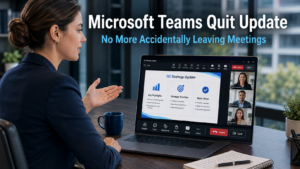
The Microsoft Teams quit update addresses something that has caught out business users more times than most people would admit. The Quit option in Teams has long sat close to other meeting controls, making it easy to click at exactly the wrong moment. Going for Share to present a screen and finding yourself suddenly staring at your desktop while a meeting carries on without you is an experience familiar to many people who use Teams regularly. Microsoft has finally moved the Quit option to a less prominent location, reducing the chance of this happening during fast-moving meetings.
What the Microsoft Teams Quit Update Changes
Microsoft has repositioned the Quit option from within the main cluster of meeting controls to the system tray, which is the small area near the clock in the bottom right corner of the Windows desktop. The rationale is straightforward. When Quit sits alongside controls that are clicked frequently during a meeting, the margin for error is narrow. Moving it to the system tray puts it at a greater distance from the controls people reach for most often, making an accidental exit considerably less likely.
The change arrives automatically on the desktop version of Microsoft Teams. There is nothing for your IT team to configure or enable. If your team uses the Teams desktop application, they will already see the updated layout.
It is worth being clear about what the update does not do. Leave, which exits the current meeting while leaving it running for others, remains within the meeting controls. The change primarily affects Quit, which closes Teams entirely. The distinction matters in practice, and users who click quickly without reading closely may still occasionally find themselves in the wrong place. However, the most disruptive error, dropping out of a meeting entirely at an unexpected moment, is now less likely to happen by accident.
A Hidden Setting That Adds a Further Layer of Protection
Alongside the layout change, Teams includes a setting that many users do not know about but that provides a useful additional safeguard. Within Teams, navigating to Settings and then General reveals an option to enable a confirmation message before leaving a meeting.
When this setting is on, attempting to leave or quit a meeting triggers a brief prompt asking for confirmation. The extra step takes less than a second. However, it creates a pause between the accidental click and the exit, giving the user the opportunity to cancel rather than dropping out of the call unexpectedly. For anyone who presents frequently on Teams or who regularly attends important client or internal meetings, enabling this setting is a worthwhile precaution.
This setting has been available for some time but is not enabled by default and tends to go unnoticed. Sharing its existence with your team, particularly with staff who use Teams heavily for client calls or presentations, is a simple step that requires no IT involvement and takes moments to configure.
Also Rolling Out: The Option to Hide the Meeting Toolbar
Alongside the Microsoft Teams quit update, Microsoft is rolling out a separate but related improvement. Teams is adding the ability to hide the meeting toolbar during calls.
The toolbar, which sits at the bottom of the screen during a meeting, occupies screen space that can be particularly valuable when presenting content or reviewing a shared document during a call. For anyone who has felt that the controls were intruding on the content being discussed, the ability to hide the toolbar temporarily provides more room to work with.
This is another small but practical improvement for teams that use Teams for presentations, training sessions, or collaborative document review. Combined with the multi-presenter slide control feature covered in our article on Microsoft Teams presentation control, these incremental updates are making Teams feel more polished and less obstructive during the moments when a smooth experience matters most.
Why Small Updates Like This Matter for Business Teams
Updates to Microsoft Teams are sometimes assessed only in terms of significant new capabilities. However, the small friction points in everyday tools have a cumulative effect on how smoothly and confidently teams operate. An accidental exit mid-sentence in a client meeting creates awkwardness that takes a moment to recover from. A presenter who loses screen space to a persistent toolbar has less room to show what they need to show.
These are not dramatic problems. However, they are repeated problems. They happen in meeting after meeting, week after week, across every member of staff who uses Teams regularly. Improvements that eliminate them compound positively over time in the same way that friction compounds negatively when left unaddressed.
For businesses in Haywards Heath and across Sussex that rely on Teams as their primary platform for client calls, internal meetings, and remote collaboration, these quality-of-life improvements reflect Microsoft’s ongoing investment in making the platform feel professional and reliable in the moments that matter.
Our article on Microsoft Teams update and productivity features covers the broader range of recent improvements that collectively make Teams a more capable business tool.
What This Means For Businesses
The Microsoft Teams quit update requires no action from business owners, IT teams, or end users. It arrives automatically on the Teams desktop application. The change is immediate and visible the next time staff use the meeting controls.
The one practical step worth taking is to share awareness of the confirmation setting within Teams Settings under General. Enabling this for staff who frequently present or attend important meetings provides an additional layer of protection against accidental exits that the layout change alone does not fully eliminate. A brief message or mention in a team communication is all that is needed.
Keeping the Teams application up to date ensures your team benefits from these improvements as they arrive. Our managed IT services include application management and update deployment for businesses across Sussex and the South East, ensuring Teams and other Microsoft 365 tools are current and properly configured across your team’s devices.
Final Thoughts
The Microsoft Teams quit update is a small change with a disproportionate benefit for anyone who has experienced the frustration of an accidental exit at an important moment. It is the kind of improvement that, once in place, you simply stop noticing, because the problem it solved stops happening.
Enable the confirmation setting in Teams for additional protection, share its existence with staff who use Teams for high-stakes meetings, and look out for the toolbar hiding feature as it becomes available. These small steps make Teams meetings feel consistently smoother and more professional.
Microsoft moved the Quit option in Microsoft Teams away from the main cluster of meeting controls to the system tray area in the bottom right corner of the Windows desktop. This reduces the chance of accidentally clicking Quit when reaching for Share or other frequently-used controls during a meeting. The change arrives automatically on the Teams desktop application with no configuration required.
It significantly reduces the risk but does not eliminate it entirely. The Leave option, which exits the current meeting while leaving it running, remains within the meeting controls. The change primarily affects Quit, which closes Teams entirely. For additional protection, enabling the confirmation message setting in Teams Settings under General adds a brief prompt before any exit, giving you a chance to cancel an accidental click.
Open Microsoft Teams and go to Settings, then select General. Look for the option to turn on a confirmation message before leaving a meeting. When this is enabled, Teams will ask you to confirm before exiting, which provides an additional safety net alongside the layout change from the quit update.
Microsoft is also rolling out the ability to hide the meeting toolbar during Teams calls. This frees up screen space, which is particularly useful when presenting content or reviewing shared documents during a meeting. The toolbar can be shown again when the meeting controls are needed. This update is rolling out alongside the quit layout change.
The quit layout change is confirmed for the Teams desktop application on Windows. The exact availability on mobile or web versions may vary. Keeping the Teams application updated ensures your devices receive these improvements as soon as they become available for each platform.