The Notepad formatting update for Windows 11 is one of those quiet improvements that sounds minor until you consider how many times each week your team opens Notepad. For quick notes, meeting summaries, checklists, and draft messages, it is often the first tool people reach for precisely because it opens instantly and never gets in the way. Microsoft is now adding a handful of optional formatting features that make it slightly more useful without changing any of the things that make it valuable.
What the Notepad Formatting Update Adds
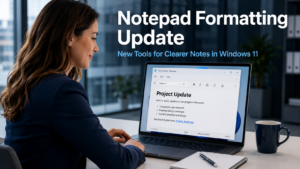
Microsoft is testing a small but practical set of formatting features within Notepad. The additions include bold and italic text, headings, hyperlinks, and basic bullet points. These are not the kind of complex formatting tools that turn a simple note-taking app into a full word processor. They are the minimum useful set for giving structure to a document without requiring a different application.
The formatting uses a system called markdown. Markdown is a widely used plain-text approach to adding structure using simple symbols rather than menu buttons. For example, placing two asterisks around a word makes it bold. Placing a hash symbol before a line creates a heading. The result is clean and readable, and importantly, it does not change the underlying plain-text nature of the file. Notepad remains Notepad.
Equally significant is that the formatting can be turned off entirely. For users who prefer a completely plain-text experience and have no interest in formatting, the new features are invisible once disabled. Microsoft has designed this as an enhancement for those who want it, not a mandatory change that alters the tool for those who do not.
Why This Matters for Business Teams
Notepad occupies a specific and useful niche in everyday business computing. It is faster to open than Word, simpler to use than OneNote, and more focused than any of the richer note-taking applications available. For a quick note during a phone call, a checklist before a meeting, or a rough draft shared with a colleague, it remains the most frictionless option on a Windows computer.
The limitation has always been that everything looks the same. A list of action points is indistinguishable from a paragraph of narrative text. A heading carries no visual weight. A meeting summary with ten different sections reads as a wall of undifferentiated characters. This is fine for personal notes read immediately and discarded. It is less than ideal for notes that will be shared or referred back to.
With the Notepad formatting update, a team member can now write a meeting summary with bold headings for each agenda item and a bullet list of action points beneath each one, all within the same fast, lightweight tool they already use. The note is clearer to write, easier to share, and more useful when referred to later. That is a genuine improvement for a tool that many businesses use dozens of times each day.
For smaller businesses in Crawley and across Sussex without complex documentation systems, Notepad with basic formatting also fills the gap left by the retirement of WordPad. There is now a built-in Windows 11 tool that sits comfortably between plain text and a full word-processing application, which is precisely the middle ground many teams need for light-touch internal documents.
What Markdown Means in Practice
Not everyone who uses Notepad will be familiar with markdown, and that is worth addressing directly. The good news is that markdown is simple enough to pick up in five minutes and does not require any technical knowledge.
To make text bold, you place two asterisks before and after it. To add a heading, you type a hash symbol at the start of the line. To create a bullet point, you start the line with a hyphen or asterisk. To add a hyperlink, you wrap the link text in square brackets and place the web address in round brackets immediately after.
None of these are difficult. For team members who write structured notes regularly, they quickly become automatic. For those who do not want to learn them, the traditional Notepad experience remains available with formatting turned off. The update genuinely adds something without taking anything away.
When to Expect the Notepad Formatting Update
Microsoft is currently testing the formatting features before a wider rollout. The update will arrive through the standard Windows 11 update process for compatible devices. No separate download or installation is required, and no action needs to be taken by businesses or their IT teams ahead of the update arriving.
For businesses running Windows 11 with automatic updates enabled, the Notepad formatting update will appear as part of a routine Windows maintenance cycle. Businesses managing updates centrally through an IT provider will receive it as part of their standard update schedule.
This update is exclusive to Windows 11. Devices still running Windows 10 will not receive it or any subsequent Windows feature updates. With free Windows 10 support having now ended, businesses still on the older operating system are missing out on a growing list of improvements. Our article on Windows 10 end of life covers what businesses in this position need to do without delay.
What This Means For Businesses
The Notepad formatting update is a small change with a proportionate but genuine benefit. Clearer notes, better-structured checklists, and more readable shared documents are all practical improvements that compound across a team over time. The feature asks nothing of users who do not want it and gives a useful upgrade to those who do.
For business owners and directors, no action is required. The update will arrive automatically for Windows 11 devices. When it does, it is worth letting your team know the formatting features are available, particularly for anyone who regularly writes meeting notes or action lists in Notepad. A brief introduction to the handful of markdown symbols involved is all the training needed.
Our managed IT services include Windows update management and device configuration for businesses across Sussex and the South East, ensuring improvements like this reach your team’s devices consistently and without any manual effort required.
Final Thoughts
Microsoft is modernising even the most established tools in Windows 11 without removing what made them useful. The Notepad formatting update is a good example of thoughtful, incremental improvement. It adds just enough to be genuinely helpful while preserving the simplicity that makes Notepad worth keeping.
For teams that use Notepad regularly, the arrival of basic formatting will be a welcome small improvement. Keep an eye out for it in the coming Windows updates.
The Notepad formatting update adds bold and italic text, headings, hyperlinks, and basic bullet points. The formatting uses a markdown system, where simple symbols such as asterisks and hash symbols create the formatting effects. All formatting features are optional and can be turned off completely for users who prefer the traditional plain-text experience.
Markdown is a simple text-based system for adding formatting using symbols rather than menu buttons. Common examples include two asterisks around a word for bold, a hash symbol at the start of a line for a heading, and a hyphen at the start of a line for a bullet point. It takes only a few minutes to learn the basics. For users who do not want to use it, formatting can be turned off entirely in the Notepad settings.
No. Microsoft has designed the update to add formatting as a lightweight, optional layer rather than increasing the complexity of the application. Notepad will remain fast and simple to open and use. The formatting features add no overhead for users who do not enable them.
The feature is currently in testing. Once it progresses to general availability, it will arrive through the standard Windows 11 update process without any separate download or installation required. Keeping Windows 11 updated ensures your devices receive the update as soon as it becomes available.
No. The Notepad formatting update is exclusive to Windows 11. Devices running Windows 10 will not receive it. With free Microsoft support for Windows 10 having ended in October 2025, businesses still on the older operating system are no longer receiving security updates either. Upgrading to Windows 11 is now a pressing priority for any business still running Windows 10.