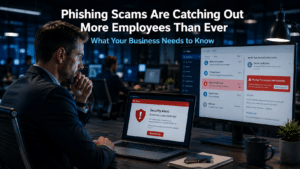
Phishing scams are no longer just a problem for large corporations. They hit businesses of every size, across every sector — and the number of employees falling victim has risen sharply. If your team regularly works with email, uses online platforms, or logs into cloud-based tools, this is something you need to take seriously.
Why Phishing Scams Are On The Rise
Recent data points to a troubling trend. The number of employees clicking on phishing links has roughly tripled over the past year. That is not a small shift. It represents a significant change in how successful these attacks have become.
So, what exactly is phishing? In simple terms, a cyber criminal pretends to be someone trustworthy — a bank, a software provider, or even a colleague — to trick a person into handing over sensitive information. That might be a password, payment details, or login credentials for a business system.
A typical example involves an email that appears to come from Microsoft. The message looks professional and convincing. It asks the recipient to click a link and re-enter their account details. The login page looks genuine. Once those details are entered, however, the criminal has everything they need to access your business systems.
If you want a broader grounding in how these attacks work, our guide on what every small business should know about phishing is a good place to start.
Phishing Scams Have Moved Beyond Email
Traditionally, phishing scams arrived almost exclusively in email inboxes. Businesses responded by training staff to be cautious with suspicious messages — and that education worked, to a degree. Criminals noticed, and they adapted.
Today, fake links appear in search engine results, social media posts, online advertisements, and even website comment sections. Criminals have deliberately spread their tactics across the web, knowing that employees are more alert to suspicious emails than they used to be.
Furthermore, trusted platforms are now being mimicked more convincingly than ever. Microsoft 365 is a prime target, given the volume of business data held within it. A fake Microsoft login page can be almost indistinguishable from the real thing.
For businesses across Sussex and the South East, this matters. Most modern businesses rely heavily on cloud platforms and digital tools. That dependency creates more potential entry points for attackers.
Why Employees Are Getting Caught Out
It would be easy to blame individual employees for clicking harmful links. However, the reality is more complicated than that.
One major factor is fatigue. Employees encounter a huge volume of emails, notifications, and messages throughout the working day. Maintaining a high level of suspicion around every single communication is simply not sustainable. Attention lapses. Mistakes happen.
At the same time, phishing scams themselves have become considerably more convincing. The days of poorly written messages full of spelling mistakes are largely behind us. Modern attacks use professional language, accurate branding, and realistic-looking websites that are difficult to distinguish from legitimate pages.
Therefore, blaming staff for being deceived misses the point. The real answer lies in giving people better tools and better training — and in not relying on human vigilance alone. Building a security-first culture across your whole organisation is one of the most effective long-term steps you can take.
The Business Impact of a Successful Attack
The consequences of a successful phishing attack can be severe. Criminals who gain access to business accounts can steal sensitive data, access financial systems, lock you out of your own files, or impersonate your business to defraud customers and suppliers.
Recovery is costly. Beyond any direct financial loss, businesses often face reputational damage, regulatory scrutiny, and significant disruption to operations. For smaller businesses in particular, the impact can be very difficult to manage. Our article on cyberattack recovery covers what that process looks like in practice.
Your employees represent both your greatest defence and your greatest point of vulnerability. A well-informed team that knows what to look for can stop attacks before any damage is done. An unprepared team, through no fault of their own, can inadvertently hand criminals the access they need.
Practical Steps to Protect Your Business From Phishing Scams
There are several concrete steps business owners can take to reduce the risk.
Train your team regularly. One-off security awareness sessions quickly become outdated. Regular, short training sessions keep phishing risks front of mind and help employees recognise new tactics as they emerge. Training should cover email-based attacks but also suspicious links on social media, search results, and unfamiliar websites.
Enable multi-factor authentication (MFA). MFA adds an extra verification step when someone logs into a system — typically a code sent to a mobile phone or generated by an app. Even if a password falls into the wrong hands through a phishing scam, MFA means an attacker cannot simply walk in using that password alone. It is one of the most effective and straightforward security measures available. You can read more about this in our guide on strengthening your business security.
Keep software up to date. Outdated software contains security gaps that criminals actively exploit. Keeping operating systems, applications, and security tools updated closes those gaps. It also reduces the risk of attackers using known vulnerabilities to gain access after a phishing attempt succeeds.
Encourage a reporting culture. Employees should feel comfortable reporting something suspicious without fear of being judged. If someone realises they may have clicked a harmful link, quick reporting allows your IT team to act fast and limit the damage.
Use email and web filtering tools. Good email filtering software catches a significant proportion of phishing attempts before they ever reach an inbox. Similarly, web filtering tools can block access to known malicious websites. Our guide on stopping spam before it stops your business explores this layer of protection in more detail.
Consider your wider IT security posture. Phishing sits within a broader cyber security picture. Achieving Cyber Essentials certification gives businesses a structured framework for covering the basics — and demonstrates to clients and partners that you take security seriously.
What This Means For Businesses
The spike in successful phishing scams over the past year sends a clear message. What worked before is no longer enough. Criminals move quickly, and businesses need to keep pace.
The right approach combines staff awareness with solid technical protection. Neither works as well without the other. Training helps employees make smarter decisions. Technology provides a safety net for the moments when those decisions are harder to make.
If your IT support arrangements feel stretched or you are not confident your current setup provides adequate protection, it is worth reviewing them. Working with a skilled IT service provider means having someone in your corner who monitors threats, manages updates, and helps keep your defences current.
Taking a proactive approach now is considerably easier — and far less expensive — than dealing with the aftermath of a successful attack.
Final Thoughts
Phishing scams are not going away. If anything, they are becoming more sophisticated and more difficult to detect. The sharp rise in successful attacks is a clear signal that the threat has evolved.
Businesses that combine regular staff education with solid technical safeguards are far better placed to protect themselves. Neither approach works as well in isolation. Training sharpens awareness. Technology catches what awareness misses.
Small, consistent actions — updating software, enabling MFA, running regular training — add up to a meaningful level of protection over time.
A phishing scam is when a cyber criminal impersonates a trusted person or organisation to trick someone into revealing sensitive information, such as passwords or payment details. It is most common via email but also occurs through fake websites, social media, and online adverts.
Criminals have improved their techniques significantly. Phishing emails and websites now look highly convincing, and attacks have spread beyond email to social media, search engines, and online platforms. Employee fatigue also plays a role — maintaining constant vigilance throughout a busy working day is genuinely difficult.
Multi-factor authentication (MFA) is a security feature that requires a second form of verification — such as a code sent to your phone — whenever someone logs into an account. Even if a password is stolen, MFA prevents attackers from gaining access. Most businesses should have MFA enabled on all key systems and accounts.
At minimum, businesses should provide phishing awareness training once a year. However, more frequent, shorter sessions are considerably more effective. Quarterly updates or simulated phishing exercises help keep awareness levels high and reflect the latest criminal tactics.
They should report it to their manager or IT support team immediately. Speed matters enormously. The faster the issue is flagged, the quicker action can be taken to change passwords, revoke access, and check for any signs of a wider breach. Employees should never feel embarrassed to report a suspected mistake.