Windows 11 spell check is a built-in feature that many business users do not realise exists, or have never taken the few minutes required to set up. Every day, businesses send emails, reports, proposals, and messages to clients and partners. A typo or spelling mistake in client-facing communication creates an impression of carelessness that is entirely avoidable. The tools to prevent this are already on your team’s computers. They simply need to be switched on.
What Windows 11 Spell Check and Autocorrect Can Do
Windows 11 includes three distinct typing assistance tools that work independently and together to improve the accuracy of written communication.
Autocorrect fixes common spelling mistakes as you type. If a team member types a word incorrectly, autocorrect identifies the error and replaces it automatically, before the word even reaches the finished text. For fast typists who make regular errors under time pressure, this is particularly useful.
Spell check highlights misspelled words by underlining them. Unlike autocorrect, which acts without intervention, spell check draws attention to potential errors and gives the writer the choice of how to correct them. This is helpful for words where autocorrect might be too confident and where human judgement is preferable.
Text suggestions offer predicted words as you type, allowing you to complete a word or phrase by pressing a key rather than finishing it manually. For commonly used business phrases or longer words, this reduces both the time spent typing and the opportunity for error. Multilingual text suggestions extend this to businesses whose teams work across more than one language, switching seamlessly based on the language being used.
How to Enable Windows 11 Spell Check Across Your Devices
Enabling these tools is straightforward and takes only a few minutes per device. Once set up, they work across most Windows 11 applications without any further configuration required.
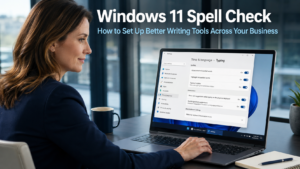
To begin, open Windows Settings from the Start menu. Navigate to Time and Language, then select Typing. On this page, you will find toggle switches for Autocorrect misspelled words, Highlight misspelled words, and Show text suggestions as I type. Switching each of these on enables the relevant tool across compatible applications system-wide.
For businesses operating in more than one language, the Multilingual text suggestions option appears on the same page. Enabling this ensures that suggestions adapt to whatever language a team member is currently writing in, without requiring a manual switch between language settings.
These settings apply to most Windows 11 applications automatically once enabled. However, a small number of commonly used business applications require their own configuration in addition to the system-wide settings.
Setting Up Spell Check in Outlook and Notepad
Outlook is the application where most business writing happens. Emails to clients, internal messages, and formal correspondence all pass through it. For this reason, taking the additional step of enabling grammar tools within Outlook itself is well worth the time.
Within Outlook, go to the Options tab and select Editor Settings. This opens a panel where autocorrect, text predictions, and grammar checking can all be enabled independently. The tone adjustment feature is also available here, which can flag where the language in an email may read as overly informal or inappropriate for a professional context. For businesses where client communication is central to the working day, these tools provide an additional layer of quality assurance.
Notepad is another application used by many businesses for quick notes and drafting that has its own separate spell check setting. Within Notepad, click the gear icon to open the settings panel and switch on spell check from there. Once enabled, misspelled words will be underlined in the same way as in other applications, allowing corrections to be made before content is copied elsewhere.
Configuring Spell Check in Microsoft Edge
For businesses that use Microsoft Edge as their primary browser, grammar and spell check tools are available within the browser settings as well. These apply to text entered into web forms, online tools, and any browser-based application.
To enable them, open Edge, click on Settings, and navigate to Languages. From there, grammar and spell check can be switched on independently. This is particularly relevant for teams that use browser-based platforms for customer relationship management, project management, or client communication, where written accuracy is equally important to the impression made in email.
Our article on the Microsoft Edge settings update covers other recent improvements to the Edge settings experience that make navigating and configuring the browser more straightforward for business teams.
Why Businesses Should Make This a Standard Part of Device Setup
The tools described in this article are free, already installed, and require less than ten minutes to configure per device. There is no software to purchase, no subscription to manage, and no training required. Yet most businesses have never set them up across their devices.
The result is that staff are writing and sending communication every day without the safety net of automated spell checking. A single typo in a proposal to a new client, a misspelled name in a supplier email, or an embarrassing autocorrection error in a formal document creates an impression that takes effort to correct and can undermine confidence in the business at a critical moment.
For businesses in Haywards Heath and across Sussex where written communication with clients is a daily activity, making spell check and autocorrect part of the standard device configuration for every new and existing team member is a straightforward and valuable step. Our managed IT services include device configuration for businesses across Sussex and the South East, ensuring that useful features like these are enabled consistently across your team rather than left to individual staff members to discover.
What This Means For Businesses
Windows 11 spell check is not a complex or expensive improvement. It is a built-in tool that most businesses are simply not using because nobody has taken the time to switch it on. The cost of not using it is avoidable errors in client-facing communication. The cost of enabling it is a few minutes of configuration.
For business owners and directors, the practical action is to ensure these tools are enabled across every device your team uses. If your IT is managed externally, this is a simple addition to a standard device configuration. If your team manages their own devices, a brief guide or a short team communication explaining the steps covered in this article is all that is needed.
Final Thoughts
Windows 11 spell check, autocorrect, and text suggestions are free tools that improve the quality of every piece of written communication your team produces. They are straightforward to set up, work across most applications, and require no ongoing management once enabled.
Taking ten minutes to configure these tools on each device in your business is a small investment with a clear return: fewer errors, more professional communication, and a better impression in every email, report, and message your team sends.
Yes. Windows 11 includes built-in spell check, autocorrect, and text suggestion tools that work across most applications once enabled. They are found in Settings under Time and Language, then Typing, and can be switched on in a few minutes. Some applications such as Notepad and Outlook require a small additional step to enable the tools within their own settings.
No. The spell check, autocorrect, and text suggestion features are built into Windows 11 and require no additional software or subscription. They are enabled through the Windows Settings menu and work immediately once switched on, across most applications that are already installed on your device.
Within Outlook, go to the Options tab and select Editor Settings. From there you can enable autocorrect, grammar checking, text predictions, and tone adjustment. These settings apply specifically to Outlook rather than to the whole system, so this step is needed in addition to enabling the system-wide spell check settings in Windows.
The system-wide spell check and autocorrect settings apply to most Windows 11 applications automatically. However, a small number of applications, including Notepad and Outlook, have their own separate settings that need to be configured individually. Microsoft Edge also has its own spell check and grammar settings found within the browser’s Languages settings page.
The most efficient approach is to include spell check configuration as part of the standard setup applied to every device in your business. If your IT is managed by a third-party provider, they can apply these settings consistently across all devices. For businesses managing their own devices, a brief guide covering the steps in Windows Settings, Outlook, Notepad, and Edge ensures every team member has the tools enabled without requiring each person to configure them independently.