
Everyone Needs Cyber Security Training: Why Tech-Confident Staff Are Not Automatically Safe
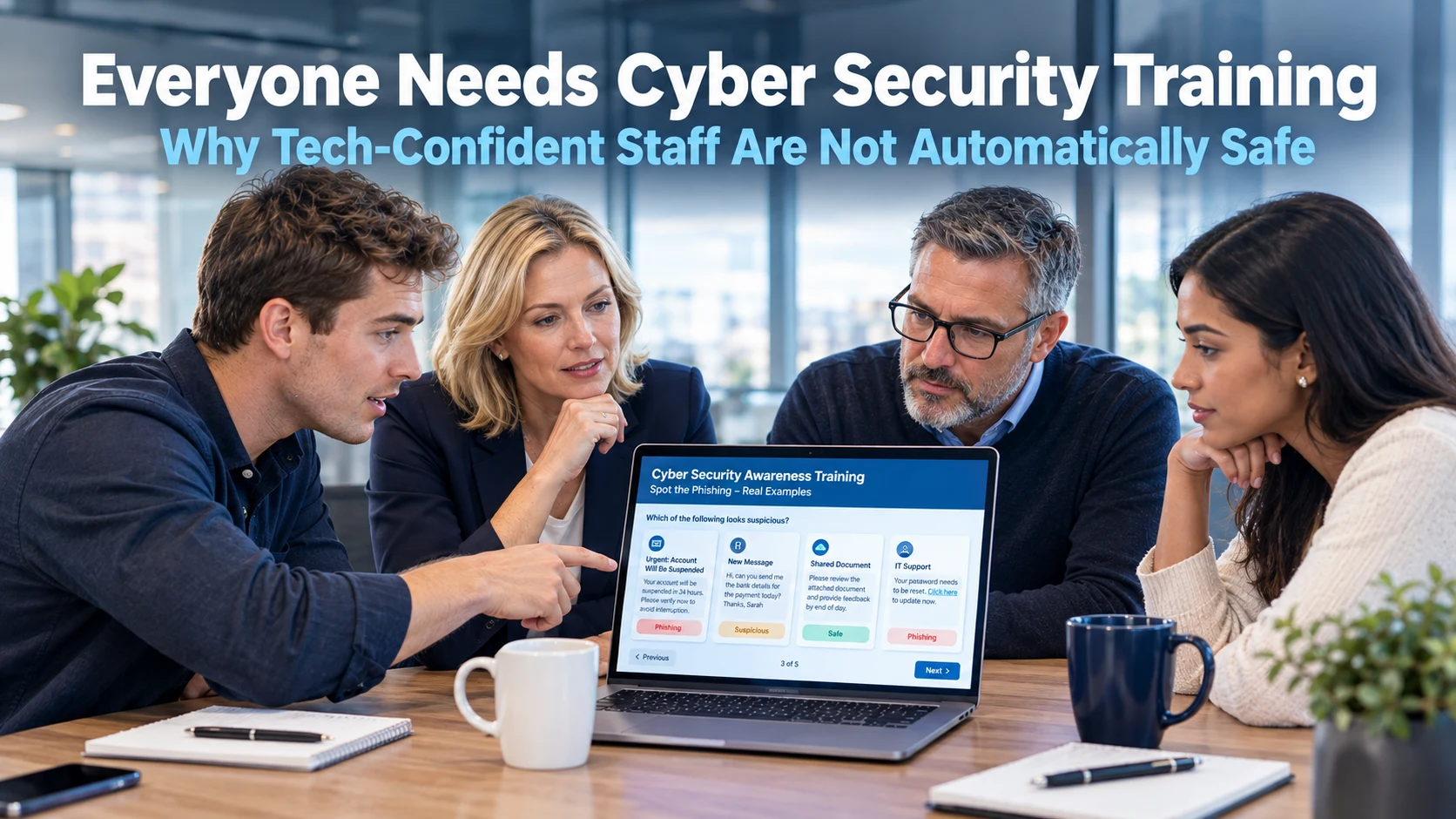
Cyber security training is something every member of a business team needs, regardless of how comfortable they are with technology. There is a widespread assumption that younger employees, those who have grown up with smartphones and social media and who navigate digital tools without a second thought, do not need much help staying safe online. That assumption is understandable. It is also one of the more reliable ways to leave a significant gap in a business’s defences.
Digital Fluency and Security Awareness Are Two Different Skills
Being comfortable with technology is not the same as understanding cyber security. These are genuinely distinct capabilities, and conflating them creates a blind spot that attackers know how to find.
Someone can switch between half a dozen apps without thinking, solve everyday technology problems in seconds, and navigate a new piece of software without reading the instructions. None of this means they will recognise a phishing email, understand why reusing passwords creates risk for the entire business, or pause before approving an unexpected sign-in request that looks familiar.
The skills that lead someone to be technically confident in everyday use are not the same skills that make them security-aware. Recognising a fraudulent email requires specific knowledge of how those emails are constructed. Understanding the implications of password reuse requires knowledge of how credential stuffing works. These things are not intuitive, and they do not come from growing up with technology. They come from training and experience that is deliberately focused on security.
Businesses that tailor their cyber security training toward people they assume are less technically capable, while expecting the more digitally fluent members of the team to pick it up naturally, are not fully covering the people those attackers are most likely to target. Our article on new staff cyber security covers how newer members of the team, who are often younger and digitally confident, are significantly more likely to fall for phishing attacks during their first three months than experienced colleagues who have developed pattern recognition over time.
Everyone Has Different Gaps
One of the most useful realisations about security awareness in a business team is that the gaps are rarely where anyone expects them to be. The assumption that experienced older staff need training and younger digitally-confident staff do not is consistently wrong. So is the opposite assumption.
One person might immediately recognise a suspicious email but use the same password across every account they hold. Another might have excellent password habits but approve an unexpected authentication request without pausing because the interface looks familiar. A third might be well-informed about phishing emails but click links in text messages or social media without applying the same level of scrutiny.
Effective cyber security training works when the whole business participates and when the training covers the full range of vulnerabilities rather than the ones most associated with a particular group. It also works when it reflects how people actually work, which has changed significantly in recent years.
How Modern Working Patterns Create New Security Gaps
A significant amount of business work now happens on mobile phones. Staff approve sign-in requests while travelling between meetings. They open documents on personal devices. They reply to emails in settings where their attention is divided. They switch constantly between business and personal applications without always maintaining a clear distinction between the two contexts.
These patterns create opportunities for mistakes that were not as significant a few years ago, when most business computing happened at a fixed desk on a managed device. A sign-in approval prompt arriving on a phone while someone is boarding a train looks exactly the same as a genuine one. An email about an urgent payment request that arrives during a busy commute gets less scrutiny than it would in a quiet office. Our article on public Wi-Fi security risks covers the specific risks that arise when work happens in mobile environments, which affect all staff regardless of their technical confidence level.
Good cyber security training helps people recognise these specific situations for what they are before they become a problem, rather than leaving each individual to work it out through experience. Experience, in a security context, often means having already made a costly mistake.
Creating a Culture Where Asking Questions Is Normal
Beyond the specific knowledge that training provides, the most valuable outcome of effective cyber security training is cultural. When everyone in a business receives regular, relevant training, asking a question about a suspicious email or an unexpected request becomes normal rather than embarrassing.
A team member who receives something they are not sure about and feels comfortable checking before they act is a significantly safer position than one where the same person makes a judgement call in isolation because they do not want to appear uncertain. The attacker’s advantage in most social engineering attacks is that the target wants to appear confident and capable and acts quickly as a result.
When security checking is a team habit rather than a sign of weakness, that advantage is substantially reduced. The person who spots something unusual and raises it is contributing to the business’s security, not demonstrating a technical gap. Making that the shared expectation is a direct result of training being something the whole business does together rather than something directed only at those deemed to need it.
Our article on employee cyber security covers how to build this kind of team-wide security culture effectively and what the most important elements of that approach look like in practice.
Training Needs to Stay Current
Cyber security training is not a one-off exercise. The attacks that reached businesses five years ago are not the attacks reaching them today, and the awareness that was current then may not prepare anyone well for what is happening now. Our article on phishing scams tripling covers how the frequency and sophistication of attacks have increased sharply in recent years, making current and regularly refreshed awareness more important than ever.
Device code phishing, real login page scams, AI-generated phishing content, and malvertising through trusted platforms are all developments in the attack landscape that have emerged or become significantly more common in the past few years. Training that does not reflect these developments leaves staff without the pattern recognition they need to identify them. For businesses in Crawley and across Sussex, keeping awareness current means treating cyber security training as an ongoing commitment rather than a box to tick periodically.
What This Means For Businesses
Every member of a business team, regardless of age, technical confidence, or role, is a potential target for a cyber attack and a potential entry point if their awareness is not adequate. The assumption that some people need training and others do not, based on how comfortable they are with technology, is one of the most common and consequential gaps in how businesses approach security awareness.
For business owners and directors, the practical action is to ensure that cyber security training covers the whole team, reflects the current threat environment, and is repeated regularly rather than treated as a single event. The goal is not compliance. It is a team that asks questions before they act and knows what to look for across the range of attacks that are actually being used against businesses today.
Our managed IT services include security awareness support and phishing simulation programmes for businesses across Sussex and the South East, helping business owners build the kind of team-wide, current, and practical awareness that actually reduces risk.
Final Thoughts
Cyber security training is for everyone. The most technically confident person in the team is not automatically the most security-aware, and assuming otherwise creates exactly the gap that attackers are looking for.
A business where every team member receives regular, relevant training and feels comfortable raising questions creates a culture that is significantly harder to deceive. That outcome is available to every business, regardless of size, and it starts with the decision that security awareness is something the whole team shares rather than something directed only at those assumed to need it.
Why do tech-confident employees still need cyber security training?
Digital fluency and security awareness are two distinct skills. Being comfortable with technology means knowing how to use applications, navigate devices, and solve everyday problems. It does not mean automatically recognising phishing emails, understanding the implications of password reuse, or knowing when to pause before approving an authentication request. These things require specific training regardless of how technically confident someone is in general.
What security gaps are most common in tech-confident staff?
Common gaps include password reuse across multiple accounts, approving unexpected authentication requests without pausing to verify them, and applying less scrutiny to requests that arrive through familiar-looking interfaces or channels other than email. Confidence with technology can actually reduce caution if it creates a feeling that nothing can catch a person out, which is the specific vulnerability that sophisticated attacks target.
How often should cyber security training happen?
At minimum annually, but more frequent and shorter sessions produce better results. Brief monthly or quarterly updates that focus on current tactics keep awareness active and current. Phishing simulations that give staff realistic experience of modern attack formats are particularly effective. The goal is ongoing awareness rather than periodic compliance.
What makes cyber security training effective across a whole team?
Training that covers the full range of current attack methods, reflects how people actually work including mobile and remote environments, and creates a culture where asking questions before acting is normal and encouraged. Training delivered to the whole team together, rather than targeted at specific groups, also reinforces that security is a shared responsibility rather than a technical concern for certain individuals.
How can I tell if our current cyber security training is adequate?
Ask when it last happened and whether it reflected current attack methods such as device code phishing, real login page scams, and AI-generated phishing content. Ask whether all staff participated or whether some were excluded on the assumption they did not need it. Ask whether staff feel comfortable raising questions about suspicious communications without concern about how they will be perceived. If any of these answers suggest gaps, that is where to focus.