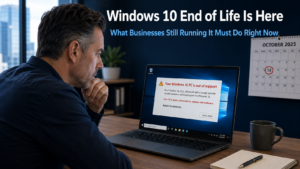
Windows 10 end of life has arrived. Microsoft ended free support on 14th October 2025, and for any business still running it, the situation is now urgent. There are no more security updates, no more bug fixes, and no more technical assistance from Microsoft if something goes wrong. Every Windows 10 device your business is running has just become significantly more exposed than it was before the deadline.
This is not a gradual transition. The change is immediate and the risk is real.
What Windows 10 End of Life Means for Your Business Right Now
The most important consequence of Windows 10 reaching end of life is the permanent cessation of security updates. Every time Microsoft discovers a vulnerability in the operating system from this point forward, it will release a patch for Windows 11. Windows 10 devices will not receive it.
Cyber criminals track end-of-life dates carefully. When support ends, they know with certainty that any weakness they find or exploit will remain permanently open on devices still running that software. Over the coming weeks and months, Windows 10 machines will become increasingly attractive targets as attackers identify and share vulnerabilities that will never be closed.
This is not a theoretical risk. Cyber attacks targeting businesses are increasing, and attackers consistently focus their efforts on systems where the defences have stopped improving. A Windows 10 device connected to your business network is, from today, a weak point that will only become weaker over time. Our article on why cyber attacks are rising covers why businesses of all sizes are now firmly in the crosshairs.
What About Microsoft’s Extended Security Updates?
Microsoft does offer Extended Security Updates as a paid option for businesses that need more time. However, these come with important caveats that businesses should understand clearly before treating them as a solution.
They are not free. The cost is charged per device and increases each year. A business with fifteen or twenty machines faces a meaningful ongoing expense for a service that provides only the most basic protection. Extended Security Updates do not bring new features. They do not improve performance. They do not provide access to any of the improvements that Windows 11 continues to receive. They simply extend a minimum level of security patching on an operating system that is otherwise at the end of its life.
For businesses that genuinely need a short breathing space while arranging a proper upgrade, Extended Security Updates can serve that purpose. However, they are not a substitute for making the move to Windows 11, and relying on them long-term is both expensive and strategically wrong.
Why Windows 11 Is the Right Answer
Windows 11 is a stronger, more capable operating system than Windows 10, and it continues to receive active investment from Microsoft in terms of security improvements, feature additions, and AI-powered tools. Moving to it is not simply a matter of compliance. It is a genuine upgrade that delivers practical benefits alongside the protection your business needs.
Security is the most significant improvement. Windows 11 includes stronger built-in defences against ransomware, phishing-related credential theft, and the types of attack that affect businesses most frequently. These protections are not available on Windows 10, and the gap will grow with every update that Windows 11 receives from here.
Performance is another benefit that businesses notice. Windows 11 makes better use of available hardware resources, which means devices often feel more responsive after the upgrade. A team that has been working on computers that have grown sluggish over time will notice the difference.
For businesses already using Microsoft 365, Windows 11 integrates more naturally with Teams, OneDrive, Outlook, and the broader suite of tools. And for the growing range of AI-powered features Microsoft is building into Windows 11, from natural language search to Fluid Dictation and Copilot integration, these are available only to businesses running the newer operating system. Our article on Windows 11 upgrade benefits covers what businesses gain from making the move.
The Hardware Question Every Business Needs to Answer
Not every device currently running Windows 10 can upgrade to Windows 11. The operating system has specific hardware requirements, including a compatible processor and a security chip called TPM 2.0. Devices that do not meet these requirements cannot be upgraded and need to be replaced.
For businesses that have not yet assessed their device compatibility, this is the most pressing first step. Knowing which machines can upgrade and which need replacing gives you a clear picture of what is involved and allows you to prioritise accordingly. Devices that handle the most sensitive data or the most business-critical functions should move first.
If hardware replacement is needed, procurement takes time. The sooner this process begins, the less disruption it creates. Waiting further delays an already overdue decision and extends the period during which your business operates on unsupported software.
Our managed IT services include hardware assessments and Windows 11 upgrade management for businesses across Sussex and the South East. We can identify which of your devices can upgrade, handle the transition, and replace any hardware that does not meet the requirements, with minimal disruption to your team.
What Needs to Happen Now
For businesses still on Windows 10, the immediate steps are clear and straightforward, even if the urgency is uncomfortable.
First, find out which devices are still running Windows 10 and which of those can be upgraded. If you do not have this information, your IT provider can establish it quickly. Second, establish a clear timeline for completing the upgrade across all eligible devices, prioritising those most critical to your operations. Third, identify any devices that require replacement and begin the procurement process immediately.
Throughout all of this, ensure your data is backed up before any upgrade takes place. Our article on how to back up your business data covers the right approach to protecting your information before significant system changes occur.
For businesses in Eastbourne and across Sussex that have not yet started this process, working with a managed IT provider is the fastest and most reliable way to move from Windows 10 to Windows 11 without operational disruption. The technical complexity, hardware assessment, and upgrade management can all be handled on your behalf.
What This Means For Businesses
Windows 10 end of life is no longer a deadline to prepare for. It is a reality to respond to. Every day that a device remains on Windows 10 is a day it operates without security updates in an environment where attackers are actively seeking and exploiting vulnerabilities in unsupported systems.
For business owners and directors, the question is no longer whether to upgrade. It is how quickly it can be done and how to minimise disruption in the process. The businesses that manage this most effectively are those that treat it with the urgency it deserves and begin the practical steps immediately.
Final Thoughts
Windows 10 end of life has passed. The protection it once received from Microsoft has stopped. The risks of remaining on it will grow with every week that follows.
Windows 11 is available, it delivers genuine improvements, and for most businesses with compatible hardware the upgrade path is straightforward. For those requiring hardware replacement, the process takes longer but the direction is clear. Act now, move quickly, and ensure your business is running on supported, protected software as soon as possible.
Microsoft stopped issuing free security updates, bug fixes, and technical support for Windows 10 on 14th October 2025. Devices still running Windows 10 continue to function, but any vulnerability discovered from that point forward will not be patched. This makes those devices progressively more exposed to cyber attack over time.
Yes. Microsoft offers Extended Security Updates as a paid option charged per device, with the cost increasing each year. These provide a minimum level of security patching only. They do not include new features, performance improvements, or any of the AI capabilities available in Windows 11. They are intended as a short-term bridge, not a long-term strategy.
Yes. The fact that a device works normally does not mean it is protected. Without security updates, any weakness found in Windows 10 will remain permanently open for attackers to exploit. Attackers specifically target end-of-life software because they know the vulnerabilities will never be fixed. The risk grows with every passing week.
Devices that do not meet Windows 11 hardware requirements cannot be upgraded directly and need to be replaced. A hardware assessment by your IT provider will quickly identify which devices qualify and which need replacing, allowing you to plan costs and prioritise the most critical machines first.
This depends on the number of devices involved and how many require hardware replacement rather than a direct upgrade. For a small business with all-compatible hardware, the technical process can be completed relatively quickly with proper planning. For businesses requiring hardware replacement, procurement timelines add to the overall timeframe. Starting immediately gives you the best chance of completing the transition with minimal disruption.