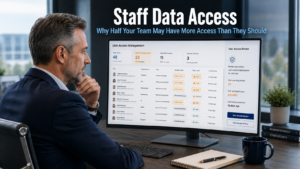
Staff data access is something most business owners set up once and rarely revisit. A new employee joins, they get access to the systems they need, and the assumption is that everything is in order. However, research tells a different story. Around half of all employees have access to significantly more business data than their role actually requires. That is not simply a matter of untidiness. It is a meaningful security and compliance risk that is leaving businesses exposed in ways they often do not realise.
What Insider Risk Actually Means for Your Business
The term insider risk describes the risk that comes from people who already have access to your systems, whether that is employees, contractors, or third-party partners. It is not a comfortable subject for most business owners, because it implies that the threat is not only external. However, understanding it clearly is important.
Insider risk has two distinct forms. The first is deliberate: a staff member intentionally misuses their access to steal data, pass information to a competitor, or cause harm. This does happen, but it accounts for a minority of insider incidents.
The second and far more common form is unintentional. Someone sends a file to the wrong person. A team member clicks on a phishing link that gives an attacker access to a system they should not have been able to reach in the first place. A departing employee retains access to cloud storage or email because their account was not properly deactivated. None of these involve bad intent. All of them have the potential to cause serious harm.
When staff data access extends far beyond what a role requires, the consequences of any mistake are amplified. The person who accidentally forwards a file to the wrong email address can only expose what they have access to. If that access is narrow and appropriate, the damage is contained. If it is broad and unchecked, the potential harm is considerably greater.
Privilege Creep: How Excessive Staff Data Access Builds Up
Most businesses do not set out to give their staff too much access. Privilege creep is how it happens gradually without anyone intending it.
An employee moves to a new role and is given access to the systems their new responsibilities require. Their access to previous systems is not removed. Over time, they accumulate permissions across multiple areas of the business that reflect their entire employment history rather than their current role. The same pattern repeats across a team, often over years, and the result is a business where access controls bear little resemblance to the current organisational structure.
Project work compounds the problem. A team member is added to a system to support a specific project. The project ends. The access is not removed. In some cases, the person does not even remember having it. In others, the data remains accessible long after it is relevant to their work.
Research confirms that only a small proportion of businesses actively and regularly review what their staff can access. The majority allow permissions to accumulate without routine scrutiny. The consequence is that large amounts of business data, including sensitive client records, financial information, and internal communications, are visible to people who have no current need to see them.
Our article on old staff logins and account security covers the related problem of access that persists after someone has left the business entirely, which is the most acute form of the same underlying issue.
The Problem of Former Employees Retaining Staff Data Access
Nearly half of businesses admit that some former employees still have active access to systems months after leaving. This is one of the most direct and preventable security risks any business faces.
A former employee with active access to your email platform, cloud storage, or business applications represents a standing vulnerability. Even if the individual has no malicious intent, their credentials may have been compromised during their time with the business or subsequently. An attacker who obtains those credentials gains access to your systems through what appears to be a legitimate account, bypassing many standard security measures.
The remedy is straightforward but requires discipline. When someone leaves, all access must be removed on the day they leave, ideally before their final session. This should cover every system they have been granted access to, not only the most obvious ones. Email and file storage tend to get addressed. Secondary tools, specialist applications, and cloud-based services often do not.
The Principle of Least Privilege and Why It Matters
The approach that addresses excessive staff data access most effectively is known as the principle of least privilege. In simple terms, this means each person should have access only to the specific systems and data their current role genuinely requires, and nothing more.
Applied consistently, least privilege limits the potential damage of any incident, whether that incident is a cyber attack, a human error, or a deliberate misuse of access. An attacker who compromises one account can only reach what that account is permitted to see. A staff member who makes a mistake can only affect what they were able to access. The blast radius of any incident is contained by design.
Just-in-time access is a further refinement of this approach. Rather than granting standing access to sensitive systems, access is provided only for the duration it is genuinely needed and then automatically removed. For high-sensitivity data or privileged administrative access, this significantly reduces the window during which any compromise could occur.
For businesses in Hailsham and across Sussex managing cloud applications, AI tools, and the broader range of software that most modern businesses use, maintaining visibility over who has access to what requires more than a one-off setup. It requires an ongoing and systematic approach.
The Growing Challenge of Shadow IT
One factor that makes managing staff data access more complex is the growing presence of what is sometimes called shadow IT. This refers to software and cloud services that staff use for work without the knowledge or approval of the IT function. A team member signs up for an online tool that solves an immediate problem. They connect it to a work email account or grant it access to cloud storage. From an IT governance perspective, this creates an invisible data access point that sits entirely outside the access control framework.
As AI-powered tools become more accessible, this issue is growing. Staff who adopt AI writing tools, research assistants, or productivity applications without IT oversight may be inadvertently granting those tools access to business data. Understanding what tools are in use across your business is a prerequisite to managing access effectively.
Our cyber security page covers how a structured approach to technology governance helps businesses maintain oversight of both sanctioned and unsanctioned tools across their teams.
What This Means For Businesses
Excessive staff data access is a risk that builds quietly over time and remains largely invisible until something goes wrong. A data breach, a compliance audit, or a regulatory inquiry can expose how widely permissions have spread in ways that would have been preventable with routine oversight.
For business owners and directors, the starting point is an honest review of who currently has access to what. This does not need to be technically complex. A structured review of each system your business uses, cross-referenced against current roles and responsibilities, will surface the gaps that need addressing.
Following that review, establishing a clear process for granting access on joining, adjusting it when roles change, and removing it immediately when staff leave creates the foundation for ongoing access hygiene rather than a periodic crisis.
Our managed IT services include access management reviews and ongoing user permission monitoring for businesses across Sussex and the South East, helping business owners maintain visibility and control over staff data access as their teams and tools evolve.
Final Thoughts
Staff data access that has grown beyond what roles require is one of the most common and most underappreciated security gaps in business IT. The risks are real, whether from accidental exposure, compromised accounts, or the lingering presence of former employees. The solution is not technically complex, but it does require consistent attention.
Review who can access what. Apply least privilege as a governing principle. Remove access when it is no longer needed, and remove it the same day someone leaves. These are straightforward disciplines that significantly reduce a risk that too many businesses carry without knowing it.
Insider risk is the risk arising from people who already have access to your systems, including employees, contractors, and partners. It covers both deliberate misuse of access and the far more common scenario of accidental exposure or mistakes. When staff have access to more data than their role requires, the potential damage from any incident is greater than it would be with tighter access controls.
Privilege creep is the gradual accumulation of access permissions beyond what a person’s current role requires. It typically happens as employees move between roles, are added to systems for specific projects, or receive access that is never removed as circumstances change. Over time, individuals can hold permissions across multiple systems that reflect their entire employment history rather than their present responsibilities.
All access should be removed on the day the employee leaves, ideally before their final session. This should cover every system the individual had access to, not only the most visible ones. A documented off-boarding checklist that includes every application, cloud service, and shared account the individual used is the most reliable way to ensure nothing is missed.
Least privilege is the security principle that each person should have access only to the systems and data their current role genuinely requires. Limiting access in this way contains the potential damage of any security incident, whether that is a cyber attack, a human error, or a deliberate misuse of permissions. It is one of the most effective and straightforward measures a business can take to reduce insider risk.
At minimum, every six months. Many businesses benefit from more frequent reviews, particularly during periods of growth, restructuring, or significant staff turnover. Building access review into the standard processes for role changes and off-boarding ensures permissions stay current rather than accumulating over time without scrutiny.